
Packaging Quality Control
Cat Litter Packaging Quality Control: Seal, Barcode, Carton, and Approval Checks
Use this cat litter packaging quality control checklist to verify seals, fill weight, dimensions, barcode, artwork, cartons, and shipment records.
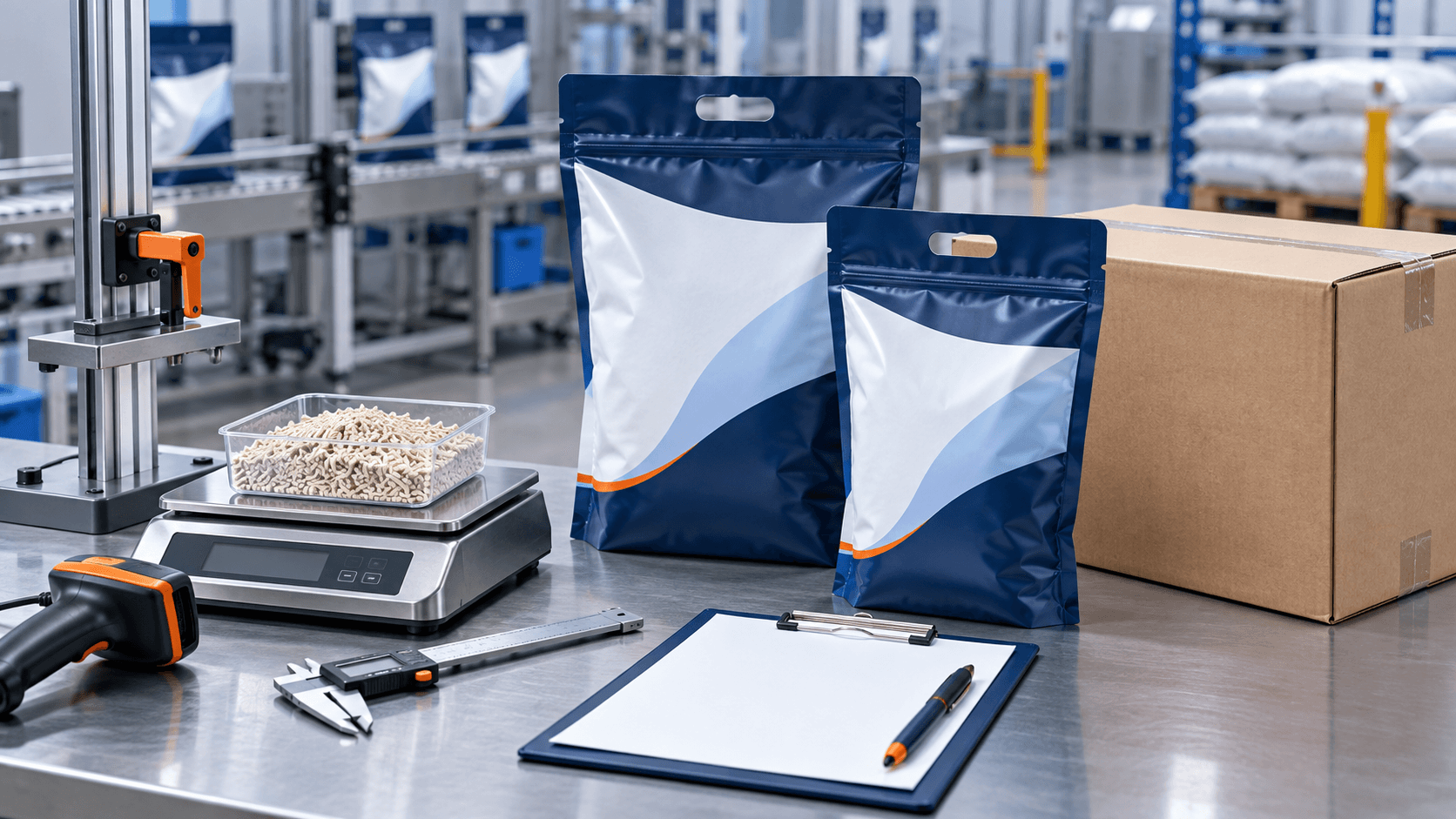
Cat litter packaging quality control should confirm that the commercial pack matches the approved product, artwork, dimensions, closure, coding, and shipping configuration before release. Importers, distributors, retailers, and private-label buyers should not approve packaging from a screen image alone. They need a controlled proof, a filled sample, a measurable inspection plan, and a record that links the product SKU to the bag, carton, barcode, and shipment. Emily Pets publishes several product and pack directions, including tofu litter references in 6 L and 8 L formats and multiple bentonite formats. These are planning references, not universal specifications. The selected SKU, approved sample, signed quotation, packaging specification, artwork proof, and sales contract should remain the controlling order documents.
What Must Be Locked Before Packaging Production?
Packaging inspection starts before printed material is ordered. The buyer and supplier should first identify the exact product SKU, formula or material direction, retail pack basis, target net content, pack structure, dimensions, closure, case count, label languages, barcode owner, destination, and artwork version. If any of these inputs remains open, the packaging team cannot create a reliable inspection standard.
Use one approval record for each SKU rather than one generic approval for an entire range. Two products can share the same brand design while requiring different net-content statements, ingredients, directions, warnings, pack barriers, date coding, or case configurations. A version-controlled proof should therefore show the SKU code, artwork filename, revision date, approvers, and the commercial order to which it applies.
Physical references also matter. A flat bag sample can confirm print and material appearance, but it cannot prove final dimensions, seal position, standing stability, handle comfort, closure performance, or carton fit. Ask for a filled or representative mock-up when those features affect shelf presentation or logistics. Mark every unverified item as conditional instead of treating it as approved.
- Exact product and SKU code
- Target net content or volume statement
- Bag or container structure and dimensions
- Closure, handle, zipper, valve, and seal direction where applicable
- Artwork filename, version, language, and approvers
- Barcode owner and destination-market data
- Case count, carton dimensions, and shipping marks
- Approved sample, quotation, and order reference
How Should Buyers Check Seals and Pack Construction?
Seal quality should be evaluated against an agreed pack specification and test method, not by appearance alone. Begin with visual checks for wrinkles across the sealing area, trapped product, contamination, incomplete bonding, burn-through, channel leaks, uneven seal width, delamination, pinholes, and damage around handles or closures. Record where a defect appears and how many units were inspected.
Then use a repeatable integrity method appropriate to the selected pack. The method may involve controlled compression, leak observation, peel evaluation, or another agreed procedure. The objective is to determine whether the commercial package remains closed during normal handling, not to claim an unsupported universal strength value. Test conditions, sample count, equipment, acceptance criteria, and failure definition should be written before results are compared.
Product contact with the seal area can create intermittent failures even when most packs look correct. Inspect packs from different points in the production run and keep defect photographs linked to batch and packaging records. If the material, fill process, zipper, temperature setting, pack size, or supplier changes, decide whether the seal approval must be repeated.
- Seal width and alignment
- Wrinkles, channels, contamination, and burn-through
- Zipper or closure engagement where used
- Handle and gusset condition
- Pinhole, delamination, and edge damage checks
- Defined integrity method and failure criteria
- Samples from beginning, middle, and end of the run
- Reapproval trigger after material or process changes
How Are Fill Quantity and Finished Dimensions Verified?
Net-content control and pack dimensions affect legal labeling, shelf fit, case configuration, freight planning, and customer experience. Define whether the order is controlled by mass, volume, unit count, or another declared basis, then identify the measurement equipment, calibration status, sampling frequency, tolerance, and responsible reviewer. Do not convert between litres and kilograms without product-specific bulk-density evidence and an agreed calculation.
Measure the finished, filled pack rather than relying only on the flat film drawing. Record width, height, depth or gusset, seal position, closure location, and any handle opening that matters to the retail brief. A filled pack may expand differently according to particle size, bulk density, compaction, headspace, and settling. Those variables should be considered when carton count and shelf dimensions are approved.
Emily Pets product pages contain published pack references for specific products, but buyers should confirm the selected SKU and quotation before applying a figure to an order. A tofu litter pack, bentonite bag, pine pellet pack, and silica crystal bag may require different measurement and loading assumptions. The inspection sheet should state the actual SKU and approved commercial basis.
- Declared quantity basis: mass, volume, or count
- Scale or measuring equipment identification
- Sampling frequency and written tolerance
- Filled-pack width, height, depth, and gusset
- Seal, zipper, and handle position
- Headspace and settling observations
- Case count and carton-fit confirmation
- Product-specific conversion evidence if units differ
What Artwork, Label, and Barcode Checks Prevent Rework?
Artwork quality control should compare the printed pack with the final approved proof, not with an earlier email attachment or design preview. Check product name, variant, net quantity, ingredients or material statement where applicable, directions, warnings, storage, responsible business details, origin wording, date-code area, barcode, language, recycling or disposal information, and every objective claim required for the destination and channel.
Assign ownership for each content block. The brand owner may control the design, the importer may provide local responsible-party information, the barcode owner may supply the symbol, and an appropriate market reviewer may confirm destination requirements. The supplier can check whether the approved content was reproduced, but should not be assumed to provide universal legal approval for every market.
Barcode inspection needs both data and print checks. Confirm that the encoded number belongs to the intended SKU, the symbol is not stretched or cropped, quiet areas are preserved, contrast is sufficient, and placement is usable on the filled pack. A phone scan is not a substitute for an agreed verification method. If the bag curves, wrinkles, reflects light, or changes dimensions after filling, test the barcode on the commercial pack and carton under realistic handling conditions.
- Final approved artwork filename and revision
- Product name, variant, and declared quantity
- Required ingredients, directions, warnings, and storage
- Responsible business, importer, and origin wording
- Date-code area and coding format
- Barcode data, size, contrast, quiet area, and placement
- Evidence owner for every objective claim
- Printed sample compared line by line with the proof
How Should Cartons and Distribution Packs Be Approved?
The retail pack and the shipping carton should be treated as one system. Confirm the number of units per case, pack orientation, dividers or liners if used, carton material specification, internal and external dimensions, gross and net weight fields, closure method, shipping marks, barcode or case label, pallet plan if applicable, and destination handling constraints. A carton approved without the final filled packs may later bulge, crush, leave excessive voids, or change loading assumptions.
Use a documented handling simulation that reflects the intended distribution route and buyer requirements. Depending on the agreed plan, this may include controlled drops, compression, vibration, stacking, temperature or humidity exposure, and post-test inspection. The exact method and acceptance criteria should be chosen for the product, package, route, retailer, and applicable standard. Avoid claiming that a generic internal test proves universal transport fitness.
After the test, inspect both carton and retail packs. Record crushing, puncture, abrasion, tape or glue failure, water exposure, print damage, seal failure, leakage, deformation, barcode readability, and product escape. If palletization is used, verify overhang, stretch wrap, corner protection, stack pattern, height, and identification against the approved loading plan.
- Units per carton and pack orientation
- Carton dimensions and material specification
- Gross and net weight fields
- Closure, tape, glue, liner, or divider details
- Shipping marks and case-label version
- Route-appropriate handling test plan
- Post-test retail-pack and barcode inspection
- Pallet pattern, overhang, height, and protection where used
Cat Litter Packaging Quality Control FAQ
When should packaging inspection happen? Use staged controls: approve the specification and artwork before printing, inspect initial printed material and filled packs at production start, sample during the run, and complete a final release review before shipment. The exact frequency and sample size should be written in the order-specific quality plan.
Is an approved artwork PDF enough? No. It can confirm intended content and layout, but buyers should also inspect a printed sample and a filled commercial pack. Color, seal position, distortion, closure function, barcode readability, dimensions, and carton fit cannot be confirmed reliably from a PDF alone.
Can one packaging test cover every cat litter SKU? Not automatically. Product density, particle shape, pack size, film structure, closure, fill process, carton count, and route can change the relevant risk. Define when an existing result may be reused and when a change triggers a new test.
Who should approve destination compliance? Assign a named responsible reviewer for the target market. The supplier can provide product, packaging, and available document information; the importer, brand owner, retailer, and qualified advisers should confirm their own destination and channel requirements.
What evidence should be retained? Keep the approved product specification, coded sample reference, artwork proof, print sample, packaging specification, inspection results, defect records, corrective actions, carton plan, and shipment-linked release record. The final signed commercial documents define the order obligations.
- Approve specification and artwork before printing
- Compare printed material with the final proof
- Inspect filled packs, not only flat bags
- Use written methods, tolerances, and sample sizes
- Link defects and approvals to SKU, batch, and order
- Retain release records with shipment documents
Practical takeaway
Effective cat litter packaging quality control connects one approved SKU to one verified retail pack, one correct barcode and artwork version, one workable carton configuration, and one shipment release record. Buyers should define acceptance criteria before production, inspect filled commercial packs, separate measured facts from visual opinions, and repeat approval when a material change affects the result. For a product-specific starting point, review the Emily Pets tofu cat litter page and then send the destination, selected formula, target pack, quantity range, artwork status, carton preference, and required review steps with the RFQ.
Explore tofu cat litter supply