
Bathing Sand Sourcing Guide
Bathing Sand Wholesale: A Buyer's Guide to Mesh Size, Dust Claims, and Retail Packs
Learn how to source bathing sand wholesale, compare mesh and moisture specifications, test dust claims, select fragrances, and plan private label packs.
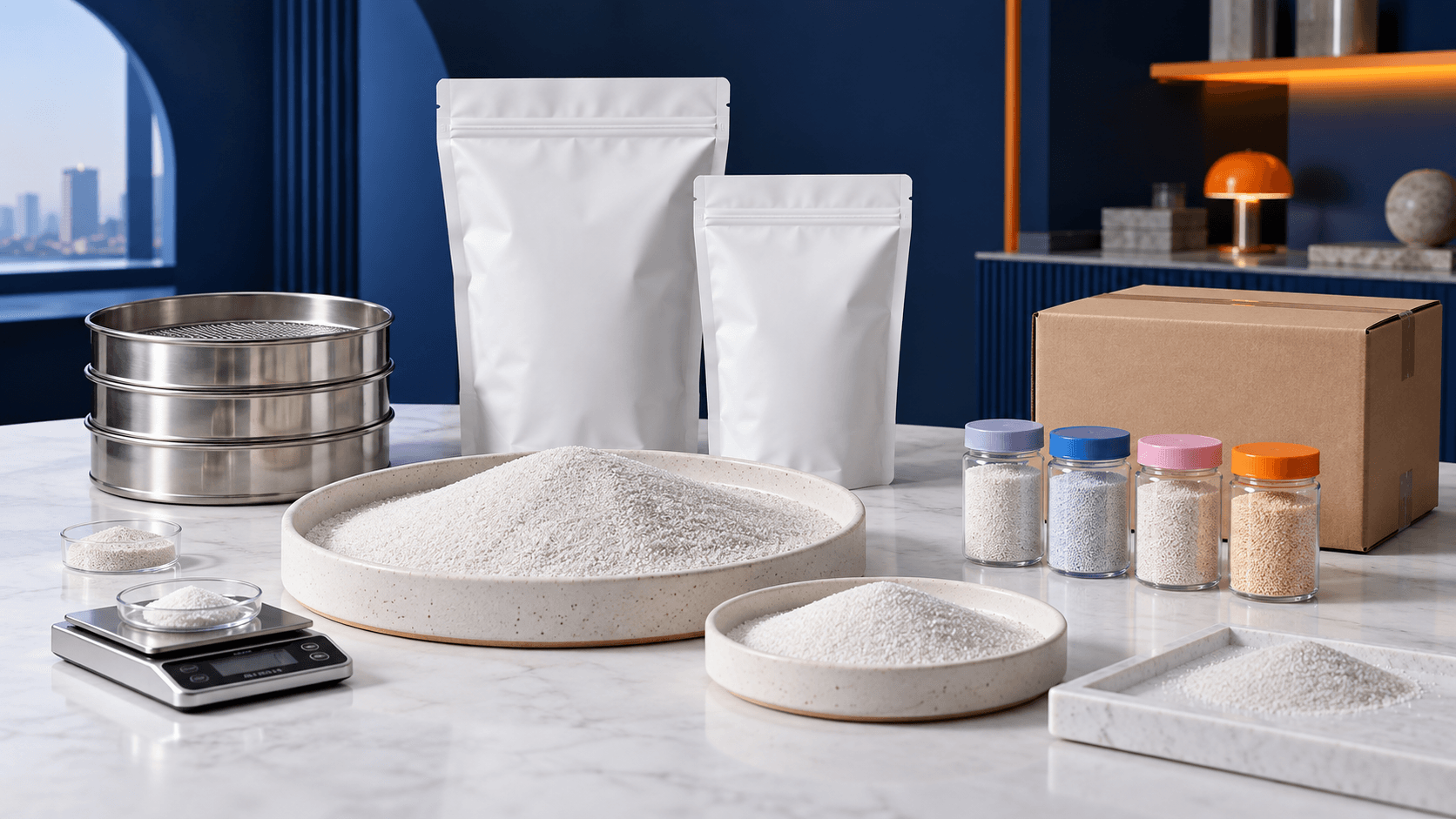
Bathing sand wholesale is the bulk or private-label sourcing of fine mineral grooming sand for small-pet retail ranges. A reliable quotation should define the raw material, mesh range, moisture limit, appearance, dust test, fragrance direction, retail pack, carton configuration, quantity, and destination. The current Emily pets product direction lists natural quartz sand, an 80-100 mesh reference, white appearance, less than 10% moisture, 500 g and 1 kg retail formats, and several fragrance options. The selected SKU, approved sample, signed specification, and final quotation must control each order.
What Is Bathing Sand Wholesale?
A bathing sand wholesale program combines the product specification with packaging and commercial decisions. It may include mineral selection, particle-size control, moisture testing, dust evaluation, fragrance sampling, retail bag and carton planning, artwork approval, quotation, production release, and shipment preparation. Private label and OEM describe how the product is sold; they do not define what is inside the bag.
A useful first inquiry states the target country, intended small-pet category, sales channel, product format, pack weight, number of SKUs, quantity range, artwork status, destination, and requested shipping basis. Buyers should identify every undecided point as a question. This helps the supplier separate confirmed specifications from options that still need sampling, testing, or quotation.
- Target country and sales channel
- Intended small-pet category
- Quartz or another confirmed material
- Mesh and appearance direction
- Unscented or fragrance options to sample
- 500 g, 1 kg, or another confirmed pack
- Quantity range and number of SKUs
- Destination and shipping basis
Which Bathing Sand Specifications Should Buyers Define?
Material, mesh range, moisture, appearance, dust, and fragrance are separate controls. Mesh describes particle-size distribution through a defined sieve system. Moisture affects storage and pack condition. Appearance provides a visual reference, while fragrance is a formula and label decision. A phrase such as fine or premium is not an acceptance criterion unless it is connected to a measurement method and approved sample.
The current Emily pets product data lists natural quartz sand; 80-100 mesh, approximately 0.15-0.18 mm; white appearance; moisture below 10%; and apple, lemon, lavender, and mint as current fragrance directions. The product page also uses dust-free wording. Buyers should treat that as a claim requiring a defined sampling and test method before it becomes an order specification or retail statement. Published figures describe the current product direction, not automatic limits for every customized order.
- Confirmed raw material
- Mesh system and accepted particle range
- Oversize and undersize sampling method
- Moisture method and limit
- Color and visual reference sample
- Dust or fines method and acceptance value
- Fragrance formula and intensity reference
- Approved and retained sample code
How Should Buyers Test Mesh, Moisture, and Dust?
A repeatable mesh test uses the same sieve standard, sample mass, shaking time, equipment, and reporting format for every candidate. Record the percentage retained on each relevant sieve rather than relying only on a stated 80-100 mesh label. Keep a coded reference sample so production can be compared with the same distribution and appearance.
For moisture and dust, define the sampling point and method before comparing numbers. A useful dust check can measure loose fines in the unopened sample, particles released during a fixed pouring test, and fines generated after a repeatable transport or handling simulation. Record sample mass, drop height, air conditions, collection method, and result. The U.S. Federal Trade Commission's advertising substantiation policy provides a useful general principle: objective product claims should have a reasonable basis before they are published. A clean photograph alone does not substantiate a dust-free claim.
- Use the same sieve standard and sample mass
- Set one shaking time and reporting format
- Measure moisture with an agreed method
- Test fines before and after handling
- Use one pouring height and collection setup
- Photograph coded samples under fixed lighting
- Record method, result, and tolerance
- Classify each sample as pass, revise, reject, or retest
How Should Fragrance and Label Claims Be Approved?
Fragrance selection should be treated as a controlled product decision, not only a color or marketing choice. Request coded unscented and fragranced samples, record the formula reference and intensity, and check how the scent changes during storage and after opening. Availability of apple, lemon, lavender, or mint should be confirmed for the selected order and packaging.
Do not assume that a fragrance name proves suitability for every species, market, or household. Product-use, safety, hypoallergenic, natural, and dust claims require evidence and destination-market review before artwork approval. The final label should accurately identify the product, net weight, intended use, storage and disposal directions, responsible business or importer details where required, barcode data, and approved claims. Keep a signed artwork version linked to the approved sample and specification.
- Unscented and fragranced sample codes
- Formula and fragrance-intensity reference
- Storage and opening observation period
- Product-use wording reviewed for the selected market
- Net weight and units confirmed
- Barcode and responsible-party data assigned
- Objective claims linked to evidence
- Final artwork version signed
How Do Retail Packs and Loading Affect the Quote?
The current published packaging references are 500 g with 24 bags per carton and 1 kg with 12 bags per carton. A complete quotation should also define the bag material and barrier, dimensions, seal or zipper, print method, units per carton, carton dimensions, shipping marks, pallet preference, and moisture protection. Product density and carton design affect the loading plan and landed-cost comparison.
The current product page lists one 20 GP container, approximately 24 metric tons, as an MOQ and loading planning reference, with lead time within 20 days after payment and T/T. These figures are not universal promises. Final MOQ, loading quantity, schedule, payment terms, and packaging charges depend on the selected product, artwork readiness, destination, and signed quotation. Request a named Incoterms 2020 rule and named place or port so cost, risk, and obligation assumptions are clear.
- 500 g or 1 kg retail format
- Bag material, dimensions, and closure
- Units per carton and carton dimensions
- Artwork, plate, and printing charges
- Palletized or floor-loaded plan
- Confirmed loading calculation
- Named Incoterms 2020 rule and location
- Final MOQ, lead time, and payment terms in writing
Bathing Sand Wholesale FAQ
What mesh size is available? The current published direction is 80-100 mesh, approximately 0.15-0.18 mm. Confirm the sieve system, distribution, method, and tolerance in the order specification. What pack sizes are available? Current references are 500 g with 24 bags per carton and 1 kg with 12 bags per carton. Final bag and carton details are confirmed during quotation.
Is the product dust free? The current page uses dust-free wording, but buyers should request a defined test method and evidence before using the claim in specifications or packaging. Which fragrances are listed? Apple, lemon, lavender, and mint are current options; availability and market suitability require confirmation. What is the MOQ? One 20 GP container at approximately 24 metric tons is a published planning reference, not a universal term. What should the first RFQ include? Send the market, intended category, material and mesh specification, sample questions, pack plan, SKU count, quantity range, artwork status, destination, and requested Incoterms basis.
- Attach one measurable product specification
- Use one test method for all samples
- List fragrance and unscented options separately
- Define packaging by SKU
- Provide quantity range and destination
- Share artwork and barcode status
- Request a named Incoterms 2020 basis
- Ask the supplier to record every deviation
Practical takeaway
A reliable bathing sand wholesale program starts with a measurable particle specification and repeatable sample tests. Confirm the material, sieve system, mesh distribution, moisture, dust method, fragrance, packaging, and loading basis; approve the product sample and artwork against the same document; and use objective claims only when the selected SKU and destination-market evidence support them.
Explore bathing sand specifications