
Cassava Cat Litter Guide
Cassava Cat Litter Wholesale: How to Verify Clumping, Dust, and Biodegradation
Learn how to source cassava cat litter wholesale, compare clumping and dust tests, review biodegradation claims, and plan private label packaging.
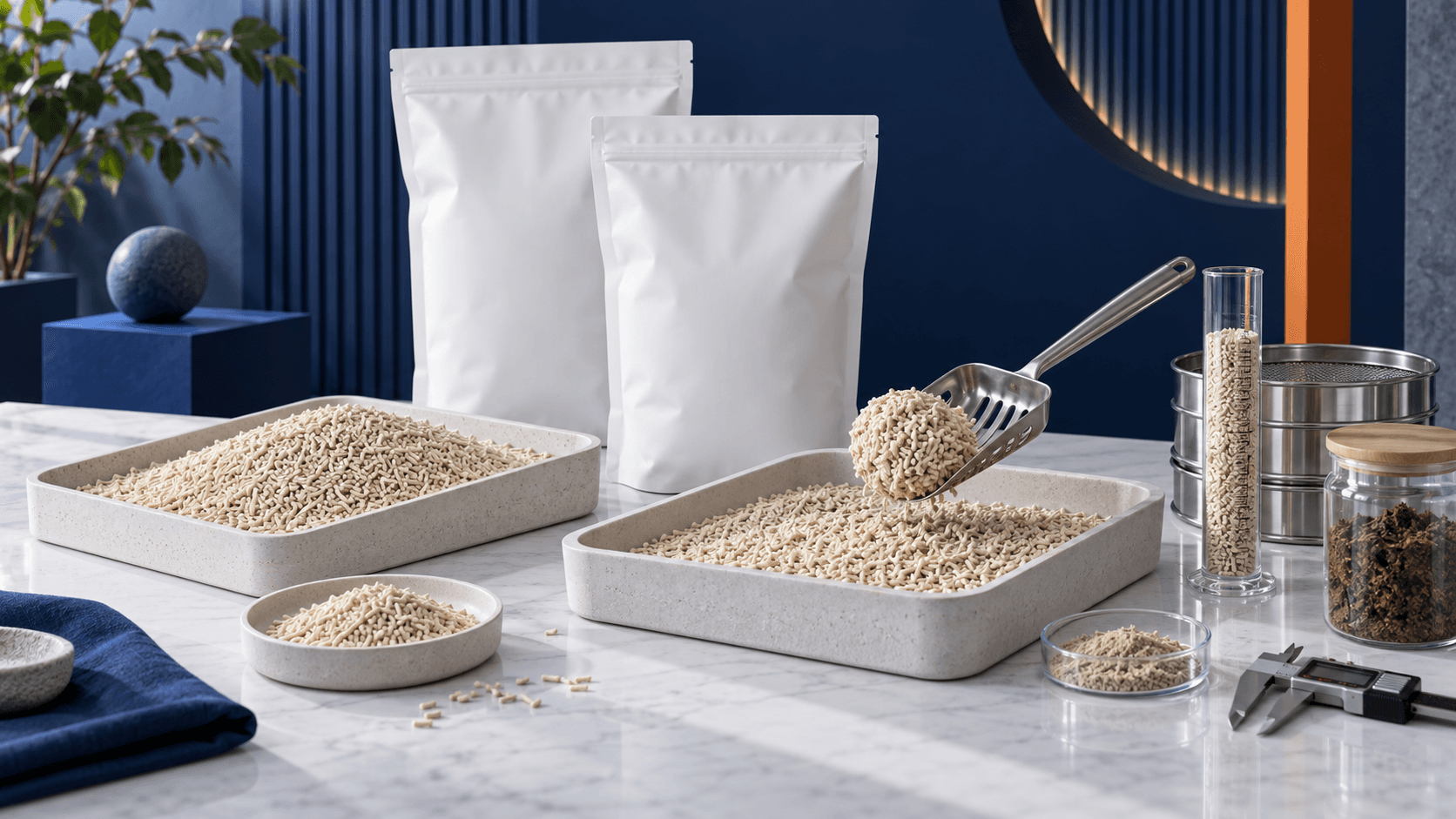
Cassava cat litter wholesale is the bulk or private-label sourcing of plant-based clumping litter made with cassava starch. A reliable buying program separates four decisions: the measurable product specification, the sample test method, the environmental claim evidence, and the retail packaging brief. The current Emily pets product direction lists 2-6 mm particles, controlled dust, neutral pH, clumping and adsorption references, and a 10 L pack. Every value and claim still needs to be tied to the selected SKU, approved sample, signed specification, and destination market.
What Is Cassava Cat Litter Wholesale?
A cassava cat litter wholesale program covers more than a bulk price. It can include formula selection, particle control, fragrance or color direction, sample testing, retail bag design, carton planning, artwork approval, quotation, production release, and shipment preparation. Private label and OEM describe the commercial arrangement, but they do not define the product that will be delivered.
A useful first inquiry explains the target country, buyer type, assortment role, target pack, expected quantity by SKU, artwork status, destination, and required shipping basis. The buyer should also state whether cassava litter will be a core product, a premium plant-based alternative, or part of a range with tofu and mineral litter. That role affects which features must be tested and how packaging should explain the difference without unsupported claims.
- Target country and sales channel
- Assortment role and competing litter formats
- Required particle and clumping direction
- Fragrance or color request, if any
- Target pack and number of SKUs
- Estimated quantity range
- Artwork and barcode status
- Destination and shipping basis
Which Cassava Litter Specifications Should Buyers Compare?
Buyers should compare cassava litter with measurable fields, not with labels such as natural, premium, or fast clumping. Particle size, undersize and oversize limits, qualified-size rate, clumping method, adsorption capacity, bulk density, moisture, pH, dust, compressive strength, and degradation method answer different questions. The test method and sampling plan are as important as the number because two suppliers can report similar values using different procedures.
The current Emily pets product data lists a cassava-starch, clumping direction with 2-6 mm particles; material below the minimum size at no more than 3.0%; material above the maximum at no more than 2.0%; clumping within 10 seconds in a 10 mL water test; adsorbent capacity at not less than 75%; a qualified-size rate of 88-95%; bulk density of 380-430 g/L; moisture at no more than 8.0%; pH 6.0-8.0; dust at no more than 1.2%; compressive strength at not less than 1.8 N; and a 10 L specification. These figures describe the current published direction, not automatic acceptance limits for every customized order.
- Ingredient and product-format wording
- Particle range plus undersize and oversize limits
- Qualified-size sampling method
- Clumping test volume, time, and pass rule
- Adsorption test definition
- Bulk density, moisture, and pH methods
- Dust and compressive-strength methods
- Approved sample code and retained reference
How Should Buyers Test Clumping and Dust?
A comparable clumping test uses the same litter mass, tray depth, water volume, application height, contact time, scoop design, and observation schedule for every sample. Record when the clump first forms, then check its shape, scoopability, surface adhesion, residue, and breakage after defined resting times. A fast visible response is not enough if the clump cannot be removed cleanly or changes after storage.
Dust should be measured at more than one stage. Separate fines present when the bag is opened from particles released during pouring and particles generated by transport or handling. Use the same sieve, sample mass, pouring height, handling sequence, and weighing method. Tracking, odor, and household acceptance depend on tray design, fill depth, environment, and animal behavior, so those observations should be recorded as use-condition results rather than universal performance guarantees.
- Use equal sample mass and fill depth
- Apply the same 10 mL or other defined liquid volume
- Record clump formation at fixed times
- Measure scoop breakage and remaining residue
- Use one sieve and weighing method for dust
- Repeat after a defined handling simulation
- Photograph results with coded samples
- Record pass, revise, reject, or retest
How Should Biodegradation Claims Be Verified?
A biodegradation percentage is meaningful only when it names the material tested, environment, duration, measurement method, and pass criterion. The current published product direction lists at least 90% biodegradation over 90 days under natural composting conditions. Buyers should request the supporting test method and report scope, confirm whether the result applies to the litter formula, the retail packaging, or both, and avoid translating one controlled result into a broader disposal promise.
Biodegradable does not automatically mean home compostable, industrially compostable, flushable, recyclable, or safe for every waste system. Used cat litter also introduces hygiene and local waste-management questions that a material test alone does not resolve. The U.S. Federal Trade Commission Green Guides provide a useful general principle: environmental marketing claims should be truthful, substantiated, and qualified to avoid misleading consumers. Final wording must also be reviewed for the destination market before artwork approval.
- Material and SKU covered by the report
- Test environment and preparation method
- Measurement method and pass criterion
- Test duration and reported result
- Laboratory or testing-party identification
- Limits and qualifications of the claim
- Separate review for packaging claims
- Destination-market disposal wording
How Do Packaging and Logistics Affect the Quote?
The current product direction uses a 10 L reference, but the retail pack still needs a complete brief. Confirm the bag material and barrier, dimensions, seal, handle or zipper, window, print method, net-volume presentation, units per carton or outer bag, pallet preference, and moisture protection. Bulk density affects the actual fill and loading calculation, while particle strength and handling affect fines after distribution.
A comparable quotation should identify the exact product specification, sample code, packaging version, tooling or printing charges, quantity by SKU, loading basis, payment terms, and validity period. No MOQ, lead time, or loading quantity is assumed in this guide. Ask the supplier to confirm them for the selected product and packaging. Request a named Incoterms 2020 rule and named place or port. Incoterms allocate specified costs, risks, and obligations; they do not replace the product specification or complete sales contract.
- 10 L or another confirmed net-volume specification
- Bag material, barrier, dimensions, and seal
- Window, handle, zipper, and print method
- Units per carton or outer bag
- Palletized or floor-loaded plan
- Bulk-density basis for fill and loading
- Named Incoterms 2020 rule and location
- Separate artwork, tooling, and packaging charges
Cassava Cat Litter Wholesale FAQ
What particle size is available? The current published product direction is 2-6 mm. Confirm the selected SKU, size distribution, sampling method, and tolerance in the order specification. What pack is available? The current reference is 10 L; the final bag, carton, artwork, and loading configuration are confirmed during quotation. What is the MOQ? No universal MOQ is stated in this guide. It depends on the selected formula, packaging, print method, SKU count, and quotation.
Which figures should buyers compare? Compare particle range, undersize and oversize limits, qualified-size rate, clumping method, adsorption capacity, density, moisture, pH, dust, compressive strength, and degradation method using the same definitions. Can environmental claims appear on the bag? Only when the selected SKU, evidence, qualification, and destination-market review support the exact wording. What should the first RFQ include? Send the target market, sample test plan, pack size, SKU count, quantity range, artwork status, destination, and requested Incoterms basis. Reference note: product figures come from current Puyuan and Emily pets cassava cat litter data; claim guidance is informed by the FTC Green Guides and shipping-basis guidance follows ICC Incoterms 2020.
- Attach one measurable product specification
- Use the same test method for every sample
- List packaging requirements by SKU
- Share artwork and barcode status
- Provide quantity range and destination
- Request a named Incoterms 2020 basis
- Ask the supplier to record every deviation
- Make the approved sample part of order control
Practical takeaway
A reliable cassava cat litter wholesale program starts with a measurable product specification and a repeatable sample method. Confirm particle distribution, clumping, adsorption, density, moisture, pH, dust, strength, packaging, and the exact scope of any degradation claim; approve the sample and artwork against the same document; and use only claims supported for the selected SKU and destination market.
Explore cassava cat litter specifications