
Private Label Planning
Original vs Fragranced Bentonite Cat Litter: A Private-Label Buyer's Guide
Compare original and fragranced bentonite cat litter for private label ranges with a clear sample brief, sensory checks, SKU plan, and artwork approval steps.
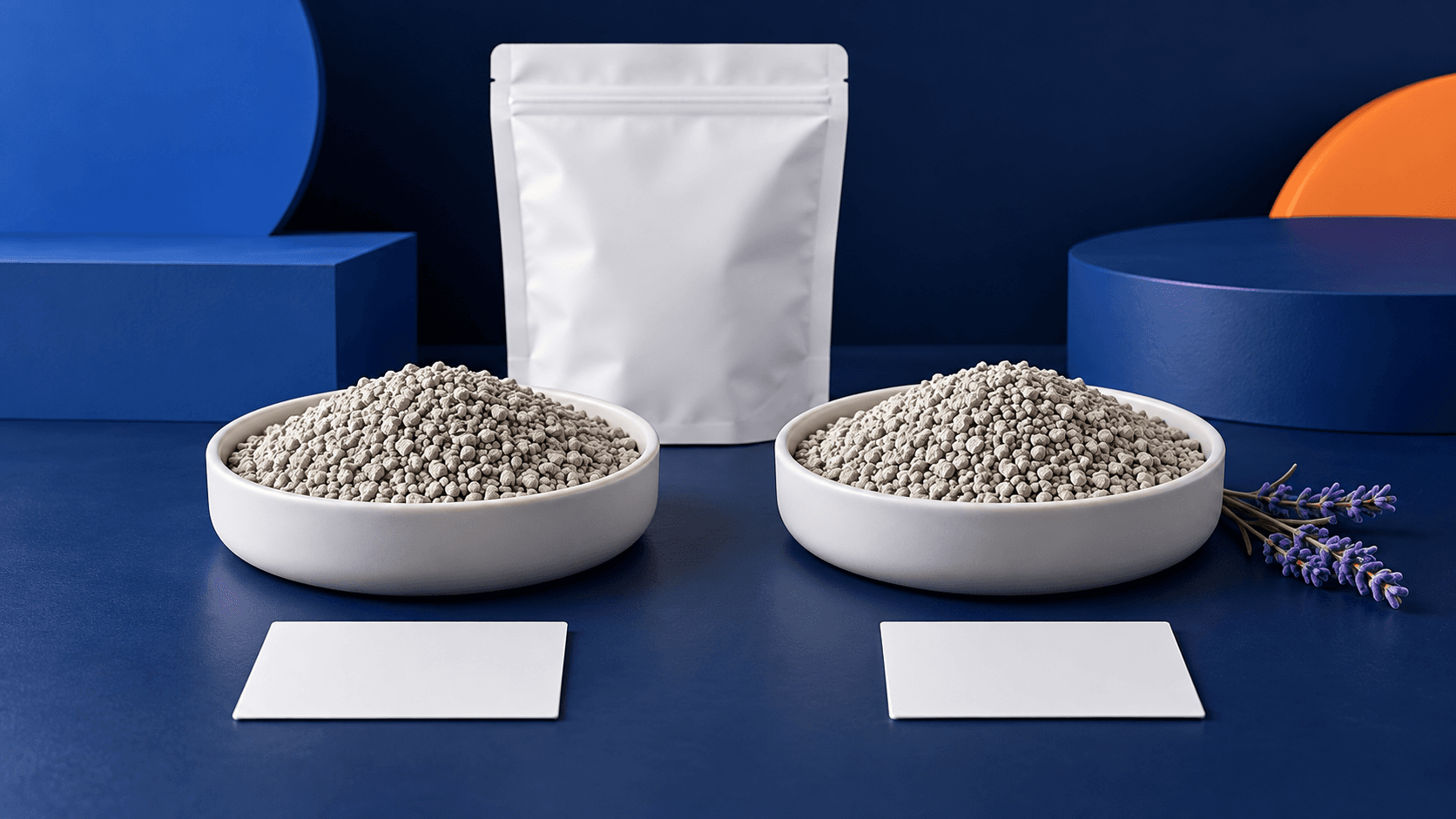
Private-label buyers should compare an original bentonite cat litter sample and a fragranced sample under the same conditions, then approve each formula, pack, and artwork as a separate SKU. A fragrance name alone does not define intensity, consistency, or odor-control performance. Emily pets currently lists an Original direction and several fragrance directions for selected bentonite products, but availability and the exact formulation must be confirmed against the chosen product and written quotation. Importers, distributors, and retailers can use the following decision process to avoid treating scent preference as a substitute for product specification.
Should a Private-Label Range Include Both Original and Fragranced Litter?
Start with the retail role of each proposed SKU. An original direction may suit a buyer who wants the mineral product experience without a named added fragrance; a fragranced direction may suit a different shelf position or shopper preference. Neither direction is automatically superior, and one market's preference should not be presented as a universal rule. Check your own channel feedback, intended price architecture, pack size, and the amount of shelf space available before adding variants.
Do not assume that the word Original means fragrance-free or unscented. Ask the supplier to state in writing whether fragrance is added to the exact sample and SKU. Likewise, a botanical scent name on a product list is not proof that the litter contains the named plant. Confirm the fragrance identity, label wording, and evidence required for the destination market before artwork approval.
Emily pets' current Love Sand bentonite information lists Original alongside Apple, Lemon, Lavender, Coffee, Rose, and Baby Powder directions for a selected product. Treat these as published discussion options, not a promise that every formula, pack, and scent combination is available on the same commercial terms.
What Belongs in a Fragrance Brief Before Samples Are Requested?
Specify the base bentonite product first: particle style and size direction, target pack, destination market, intended channel, quantity range, and whether the project is stock packaging or private label. Then list the scent direction separately. This makes it possible to compare two samples that differ in one planned variable instead of comparing different base litters and assuming the scent caused every difference.
Ask for a sample code and a written description of each variant. For an original version, clarify whether any fragrance is added. For a fragranced version, record the fragrance name or code, intended intensity direction, and whether the supplier can provide a matching filled-pack sample. The final agreed sample and specification, rather than a generic catalog image, should control the order.
State which decisions remain open. A buyer may be ready to shortlist a scent while still needing to approve pack barrier, artwork language, barcode ownership, carton count, or destination documentation. Keeping these as separate approvals helps prevent a sensory preference from being mistaken for full product sign-off.
- Base bentonite SKU and particle direction
- Original or named fragrance direction, with sample code
- Written confirmation of whether fragrance is added
- Target pack, market, channel, and quantity range
- Intensity reference and filled-pack sample request
- Open product, packaging, artwork, and document approvals
How Can Buyers Compare Scent Samples Fairly?
Use coded samples and a repeatable observation sheet. Open comparable quantities in the same room, at the same time after unpacking, with the same ventilation and container type. Record the initial mineral or fragrance impression, intensity, any unusual odor, and whether the impression changes after a defined period. Sensory observations are subjective; collect notes from more than one reviewer when the buying decision depends on them.
Repeat the review with the proposed retail pack. Packaging material, seal quality, storage conditions, and time in a closed bag can change what a reviewer notices at opening. Record the sample date, packaging format, lot or code, storage history, and observation time so later samples can be compared against the approved reference. Do not claim measured odor-control efficacy from a sniff test.
Keep the scent assessment separate from functional checks. Particle distribution, fines, clumping behavior, moisture, pack integrity, and net content still need their own agreed methods and acceptance criteria. If a fragrance variant uses a different base formulation, state that difference explicitly rather than presenting the samples as a one-variable comparison.
- Same sample mass, container, room, and ventilation
- Coded samples and more than one reviewer where useful
- Initial and later observation times
- Filled-pack and storage-condition notes
- Separate records for scent, product performance, and pack integrity
- Approved reference sample linked to the final SKU
How Should Scent and Odor Claims Appear on Private-Label Artwork?
Approve the product and the words on its pack together. The scent name, variant color, product identity, net-content statement, use and storage instructions, barcode, and destination-market information should match the selected sample and SKU. A switch from Original to a fragranced formula is a product and artwork change, not merely a color change on the same bag.
Avoid turning fragrance preference into an unverified performance claim. Terms such as eliminates odor, antibacterial, safe for all cats, natural lavender, or fragrance-free require their own evidence and appropriate market review. A supplier's list of fragrance options does not establish those claims. The buyer, brand owner, importer, and qualified local reviewers should agree who approves the final destination-specific wording.
Keep a version-controlled record of the formula code, sample approval, fragrance description, artwork proof, printed pack, and quotation. If the fragrance, concentration, pack material, or label wording changes, decide which approvals must be repeated before the revised SKU is released.
Private-Label Fragrance Planning FAQ
Is Original the same as unscented? Not necessarily. Original is a published variant name in the current product information. Ask for written confirmation that no fragrance is added before using unscented or fragrance-free wording on a pack.
Which fragrance is best for every market? There is no universal answer. Compare the selected samples with your own channel feedback and destination requirements. Approve a coded physical reference rather than relying only on a fragrance name.
Can the same artwork be used for every scent? The design system may be shared, but each SKU needs its own correct variant name, barcode data, formula-linked claims, and approved proof. Confirm which label elements differ before printing.
Does a stronger scent prove better odor control? No. Scent intensity is a sensory observation; odor-control performance needs a defined method and evidence for the exact product and claim. Keep the two evaluations separate.
Practical takeaway
Build a scented-and-original bentonite range only when each variant has a clear shelf role and a separately approved sample, specification, and pack. Begin the RFQ with the base product, destination, target pack, quantity range, fragrance direction, and the claims you intend to review. Compare samples under consistent conditions, document whether fragrance is added, and approve artwork only after the final SKU is defined.
Review Love Sand bentonite cat litter