
Pine Cat Litter Guide
Pine Cat Litter Wholesale: A Buyer's Guide to Pellets and Private Label
Learn to source pine cat litter wholesale, define pellet specifications, evaluate non-clumping performance, plan packaging, and compare private label quotes.
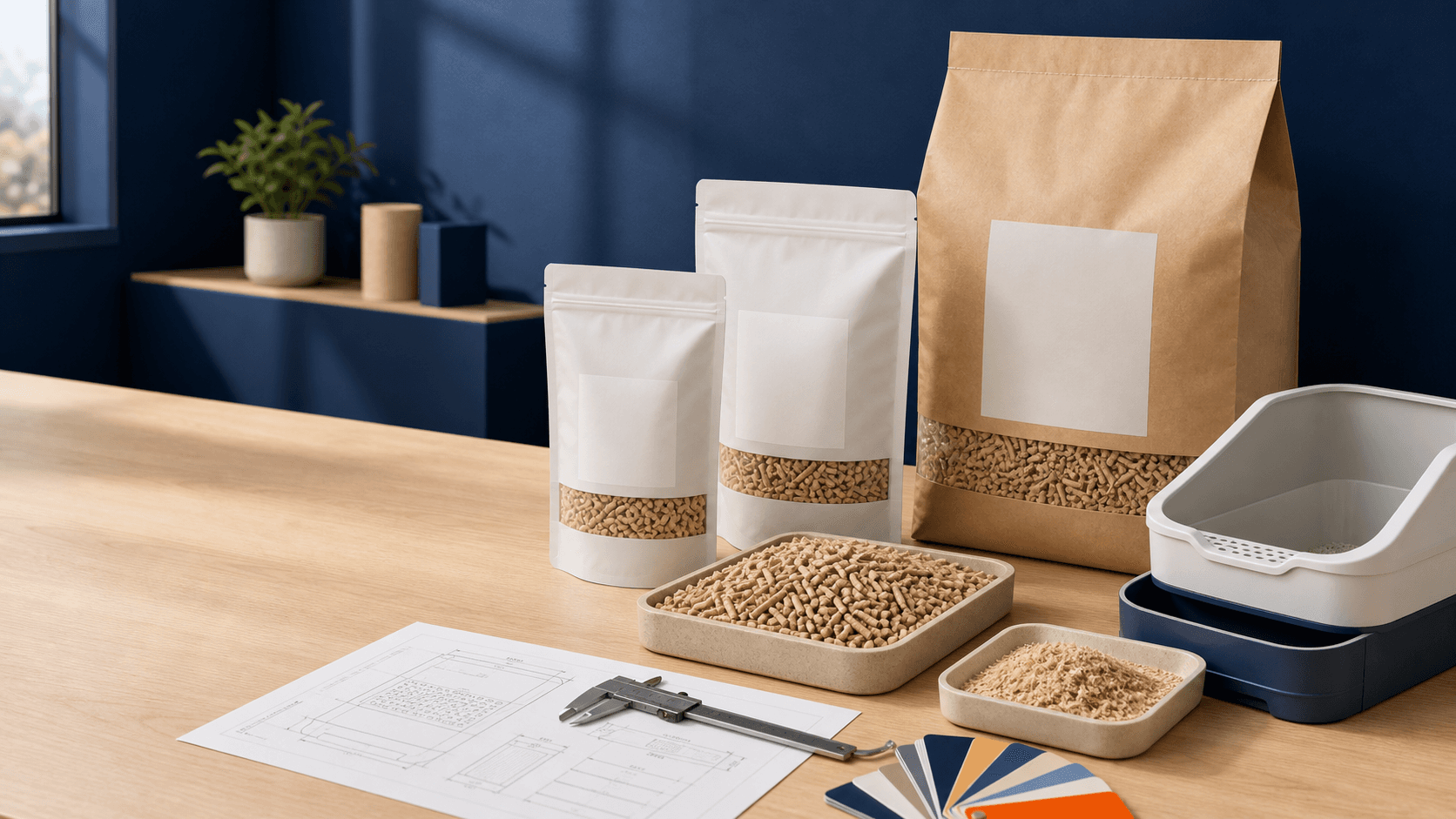
Pine cat litter wholesale is the bulk or private-label sourcing of compressed wood pellets for retail, distributor, or brand programs. A reliable quotation requires more than a target bag size: buyers should define the raw-material direction, pellet dimensions, moisture and density limits, wet-use behavior, packaging, quantity, and destination. For the current Emily pets pine pellet direction, the published specification lists a non-clumping format intended for double-layer litter boxes. Pellets break down into powder after liquid contact. Other wood litter formulas may behave differently, so the selected SKU and approved sample must control the product claim.
What Is Pine Cat Litter Wholesale?
Pine cat litter wholesale covers the commercial supply of wood-based litter in retail packs, larger bags, or a buyer's private-label packaging. The program may include material selection, pellet dimensions, sample testing, bag and carton planning, artwork coordination, quotation, production approval, and shipment preparation.
The first decision is the product mechanism. Some wood litters are marketed as clumping granules, while many pine pellets are non-clumping and disintegrate into sawdust after absorbing liquid. Those products are not interchangeable. The buyer brief should state whether the intended consumer will use a standard tray or a double-layer litter box and how used material should move through the sieve.
Private label, OEM, and wholesale are commercial labels, not technical specifications. A useful inquiry explains the market, channel, product mechanism, net weight, quantity range, brand status, and requested shipping basis.
- Target country and retail channel
- Non-clumping pellet or another confirmed wood-litter format
- Standard or double-layer litter-box use
- Retail or bulk pack requirement
- Estimated quantity by SKU
- Private label artwork status
- Destination and quotation basis
Which Pine Pellet Specifications Matter Most?
Pellet dimensions, moisture, ash, and bulk density affect handling, pack fill, transport, and user experience. They should be written as measurable ranges with an agreed test method rather than described only as "premium" or "high absorption."
The current Emily pets product data lists pine wood, wood fiber, or mixed wood as the available feedstock direction; 4–8 mm pellet diameter; 30–50 mm length; moisture at no more than 10%; ash content at no more than 0.7%; and bulk density of 600–750 kg/m³. These figures describe the published product direction, not an automatic guarantee for every customized order.
Material wording must match the selected SKU. A mixed-wood formula should not be labeled "100% pine." Likewise, the buyer and supplier should agree how diameter, length, moisture, ash, density, and fines are sampled and measured before those numbers become order acceptance criteria.
Pellet color, natural odor, surface finish, broken-pellet percentage, and loose fines may also matter to retail presentation. Approve these attributes against a coded reference sample and retain that sample for production comparison.
- Confirmed raw-material description
- Pellet diameter and length range
- Moisture test method and limit
- Ash-content test method and limit
- Bulk-density test method and range
- Broken pellets and loose-fines limit
- Color and natural-odor reference
- Approved and retained sample code
How Should Buyers Test a Pine Cat Litter Sample?
A useful sample test reproduces the intended litter-box system and records the method. Pour depth, sample mass, liquid volume, liquid temperature, contact time, sieve opening, room conditions, and observation time should be the same for every candidate.
For a non-clumping pine pellet, evaluate dry pellet integrity first, then add a controlled liquid volume and record absorption, expansion, disintegration, wet sawdust texture, and transfer through the double-layer tray. The test should show how much intact material remains, how easily used material separates, and whether the result matches the intended cleaning instructions.
Dust should be separated into at least two questions: loose fines present when the bag is opened and particles created during shipping, pouring, or pellet breakdown. A claim such as "dust free" needs a defined method and evidence. Visual inspection alone is not enough when the claim will appear on retail packaging.
Odor, tracking, and litter-box acceptance are use conditions rather than single laboratory numbers. If they are part of the buying decision, define a repeatable evaluation and avoid converting a limited sample result into a universal health or performance promise.
- Use the intended litter box and fill depth
- Record pellet mass and liquid volume
- Measure time to absorb and disintegrate
- Check sawdust transfer through the sieve
- Compare intact pellets after the test
- Measure loose fines before and after handling
- Photograph results at fixed time points
- Record pass, revise, reject, or retest
How Do Packaging and Loading Affect the Quotation?
Pine pellets are sold by weight but occupy volume according to bulk density and pack design. The bag structure, dimensions, net weight, headspace, closure, carton or outer-bag configuration, and pallet preference can therefore change both the unit quotation and the loading plan.
Published Emily pets pack references include 4 kg, 8 kg, 15 kg, and 25 kg. PP bags, paper bags, cartons, and bulk packing are listed as possible directions. The final pack must be confirmed against the selected product, quantity, print method, handling requirements, and destination market.
The current product page also lists one 20 GP container, approximately 18 metric tons, as an MOQ and loading planning reference. Buyers should not treat that number as universal: density, bag size, palletization, container restrictions, and the confirmed order can change the commercial result. The signed quotation and sales contract define the final MOQ, loading quantity, lead time, and payment terms.
Ask for a clearly named Incoterms® 2020 rule and place or port. ICC explains that Incoterms® rules allocate cost, risk, and obligations between seller and buyer. They do not replace a complete contract, and a price labeled only "FOB" or "EXW" is incomplete without the named point.
- Net weight and bag dimensions
- Bag material, closure, and print method
- Units per carton or outer bag
- Palletized or floor-loaded plan
- Confirmed bulk-density basis
- Expected container and loading calculation
- Incoterms® 2020 rule with named place
- Separate packaging, artwork, and tooling charges
How Should Private Label Claims Be Approved?
Private label artwork should begin with the approved product specification, not with a competitor's package. The label needs an accurate material name, product format, net contents, directions for use, disposal guidance, responsible company or importer information where required, barcode data, and claims supported for the destination market.
Instructions should explain the intended tray system. For the current non-clumping pellet direction, consumers need to understand that wet pellets break down and that a double-layer box helps separate used sawdust from intact pellets. The exact fill depth, cleaning routine, and disposal instruction should be validated for the selected product.
Environmental claims require evidence. The U.S. Federal Trade Commission's Green Guides state that environmental marketing claims should be truthful and substantiated and should be qualified where needed. Terms such as "biodegradable," "compostable," "eco-friendly," "recyclable," or "flushable" should not be copied into artwork without product-specific support and a review of local disposal systems and market rules.
Final artwork approval should identify the dieline, language version, barcode owner, net-content basis, claim evidence, and version number. A written sign-off prevents the product sample, label, outer carton, and purchase order from describing different goods.
- Material name matches the selected feedstock
- Product mechanism is described accurately
- Use instructions match the approved sample
- Net contents and units are correct
- Barcode and responsible-party data are assigned
- Environmental and performance claims have evidence
- Destination-market review is complete
- Final artwork version is signed
Pine Cat Litter Wholesale FAQ and RFQ Checklist
Is pine pellet cat litter clumping? The current Emily pets pellet direction is specified as non-clumping: pellets break down into powder after liquid contact and are intended for a double-layer litter box. Other wood-litter formulas may differ, so confirm the exact SKU and test sample.
What pack sizes are available? Published references include 4 kg, 8 kg, 15 kg, and 25 kg. Retail artwork, bag structure, cartons, outer bags, and bulk formats are confirmed during quotation and packaging review.
What is the MOQ? The published planning reference is one 20 GP container at approximately 18 metric tons. The final MOQ and loading quantity depend on product density, packaging, palletization, and the confirmed quotation.
Can a buyer request 100% pine? The available material direction includes pine wood, wood fiber, or mixed wood. The label and specification must identify the selected feedstock accurately; availability and commercial terms require confirmation.
What should a first RFQ include? Send the target market, use format, pellet specification, sample questions, retail or bulk pack, quantity range, private label requirements, destination, and requested Incoterms® basis. Mark every unconfirmed item as a question rather than an assumed specification.
Reference note: product figures in this guide come from the current Emily pets and Puyuan published pine cat litter data. Claim guidance is informed by the U.S. FTC Green Guides, and shipping-basis guidance follows ICC Incoterms® 2020. Destination-market labeling, disposal, and import requirements need qualified local review.
- State non-clumping or other required mechanism
- Attach the target pellet and test specification
- Define the intended litter-box system
- List pack weights and number of SKUs
- Share artwork and barcode status
- Provide quantity range and destination
- Request a named Incoterms® 2020 basis
- Ask the supplier to record every deviation
Practical takeaway
A reliable pine cat litter wholesale program starts with a defined pellet and use system. Confirm the feedstock, diameter, length, moisture, ash, density, fines, and wet disintegration behavior; test the sample in the intended double-layer tray; align the pack and loading plan; and approve only claims supported for the selected product and destination market.
Explore pine cat litter specifications