
Private Label Guide
Cat Litter Wholesale: A Practical Guide to Custom and Private Label Programs
Learn how custom cat litter wholesale works, what specifications buyers should define, how private label packaging is approved, and how to compare quotations.
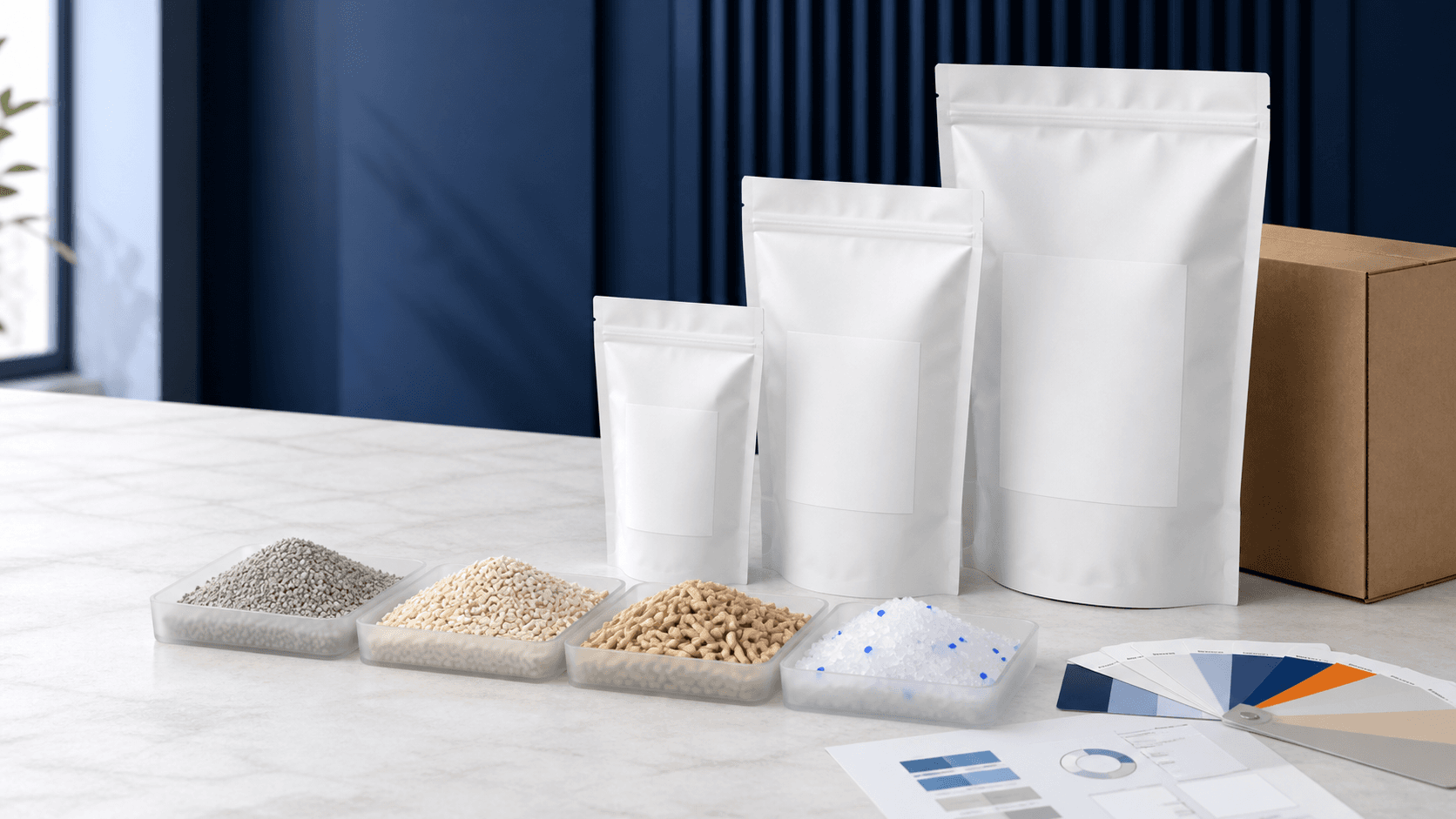
Custom cat litter wholesale means sourcing a defined litter product in retail or bulk packaging under the buyer's brand. The fastest route to a usable quotation is to align six items: litter material, performance specification, pack size, artwork and label needs, quantity range, and destination market. A supplier cannot price "custom cat litter" accurately from a logo alone. Bentonite, tofu, pine, silica gel, and cassava litters differ in density, particle format, packaging, loading, and claim requirements. A strong buyer brief connects the product specification to the commercial and regulatory plan.
What Does Custom Cat Litter Wholesale Include?
A custom cat litter wholesale program normally covers more than putting a logo on a bag. The agreed scope may include the litter material or formula, particle format, fragrance direction, retail pack, outer carton, shipping marks, label copy, sampling, artwork approval, and production reference standard.
"Private label," "OEM," and "ODM" are used differently across suppliers and markets. Instead of relying on the term alone, buyers should define who owns the brand, who supplies the artwork, which product attributes may change, and which approved sample or specification will control production.
For a first quotation, send a concise commercial brief rather than a general request for the lowest price. The supplier can then confirm which options are standard, which require development, and which details must wait for sample or packaging validation.
- Target market and sales channel
- Preferred litter material and clumping format
- Unscented or fragrance direction
- Retail pack weight or volume
- Estimated quantity range by SKU
- Private label, carton, and shipping-mark requirements
- Requested quotation basis and destination
Which Cat Litter Type Fits the Target Market?
The right material depends on the target consumer, shelf price, pack handling, disposal expectations, and local label rules. No single cat litter type is automatically best for every private label program.
Bentonite cat litter is a familiar mineral clumping format and can support everyday retail, wholesale, and private label ranges. Buyers should evaluate granule size, dust-control test method, clump strength, fragrance, bulk density, and the effect of pack weight on logistics.
Tofu and cassava litters are plant-derived directions. Their clumping behavior, particle format, moisture control, and disposal instructions should be tested for the intended formula. Do not place broad "biodegradable," "compostable," or "flushable" claims on a package without product-specific evidence and a destination-market review.
Pine formats may use pellets or other structures and can be designed for different litter-box systems. Silica gel cat litter uses crystal formats with different density and moisture-adsorption characteristics. In every case, compare an approved sample against measurable acceptance criteria rather than comparing material names alone.
- Bentonite: mineral clumping direction and familiar retail positioning
- Tofu or cassava: plant-derived positioning with claim review
- Pine: pellet or alternative format matched to the litter-box system
- Silica gel: crystal format with product-specific adsorption targets
- Choose by consumer use case, not by material trend alone
What Specifications Should a Buyer Send First?
A sourcing specification should separate measurable targets from marketing language. Terms such as "low dust," "fast clumping," or "strong odor control" are useful goals, but they are not acceptance criteria until the parties agree on a test method, sample condition, and acceptable range.
Start with material or formula direction, particle-size range, clumping or absorption method, dust-control method, moisture, bulk density, fragrance, color, and retail pack size. Add any market-specific restricted-substance, safety, or label requirements that the supplier must review.
Use an approved reference sample or signed technical sheet as the production benchmark. If the formula, fragrance, granule size, or packaging changes after sampling, confirm whether a new approval is required. This prevents the quotation, sample, artwork, and order from describing four different products.
- Material or formula code
- Particle or pellet size range
- Clumping, absorption, or disintegration test method
- Dust and moisture test method
- Bulk density and pack-fill basis
- Fragrance, color, and additive direction
- Approved sample and acceptance limits
- Change-control contact on both sides
How Does Private Label Packaging Approval Work?
Packaging approval begins after the product and pack format are sufficiently defined. The supplier can coordinate the applicable dieline, bag or container direction, label panels, pack size, outer-carton details, and production artwork checks. Final dimensions, fill, packing method, and print requirements should be confirmed for the selected specification and order.
The brand owner should prepare accurate product copy for the destination market, including net contents, languages, responsible business or importer details where required, use and disposal instructions, barcode data, and substantiated claims. GS1 guidance states that the organization that owns the trade-item specification is normally responsible for assigning the GTIN, even when another company manufactures the product.
Environmental language deserves a separate evidence review. The U.S. Federal Trade Commission's Green Guides, for example, caution against broad unqualified environmental benefit claims and require support for compostable or degradable claims. Other markets may apply different rules, so packaging copy should be reviewed locally before print approval.
Use a final artwork checklist and require written approval before production. A small pack-size change can affect net-content text, barcode allocation, carton quantity, palletization, and the final landed cost.
- Confirmed dieline and print area
- Final brand and product name
- Destination-market languages and mandatory text
- Net contents and unit format
- Brand-owner or importer information where required
- GTIN or barcode responsibility
- Supported performance and environmental claims only
- Signed final artwork and version number
How Should Buyers Compare Cat Litter Wholesale Quotations?
Compare quotations only after normalizing the commercial basis. Two offers are not equivalent if they use different litter formulas, pack sizes, bag structures, carton quantities, order volumes, or freight responsibilities.
Create a comparison table with the same product specification, approved packaging scope, quantity range, inspection expectation, sample or artwork charges, palletization, and shipping basis. Convert the result to a cost per retail pack or another common unit, then add destination-side costs that are outside the supplier's quotation.
State the Incoterms® 2020 rule and the named place or port precisely. The International Chamber of Commerce explains that Incoterms® rules allocate cost, risk, and obligations; they do not replace the full sales contract. A quotation that says only "FOB" or "EXW" without a named point is not sufficiently clear for a reliable comparison.
MOQ, lead time, container loading, and freight depend on material, pack size, quantity, season, and the confirmed quotation. Treat website figures or early estimates as planning references only until they appear in the final quotation or contract.
- Same product and test specification
- Same net contents and packaging structure
- Same quantity range and number of SKUs
- Same carton and pallet assumptions
- Same Incoterms® 2020 rule and named place
- Separate tooling, artwork, sample, and inspection charges
- Comparable cost per retail pack
- Written validity period and exclusions
What Is the Fastest Path from Inquiry to Repeat Order?
The most efficient sequence is: buyer brief, technical confirmation, quotation, sample approval, artwork approval, pre-production confirmation, order, inspection or document review, shipment, and a controlled repeat-order specification. The exact timing depends on the product and packaging scope; a disciplined approval path matters more than a generic lead-time promise.
Can buyers customize both formula and packaging? Often yes, but the available formula, fragrance, granule, pack, and print options vary by product. Ask the supplier to mark each requirement as standard, adjustable, or subject to development.
What is the MOQ for private label cat litter? There is no responsible universal answer. MOQ depends on the litter material, pack size, print method, number of SKUs, and production plan. Request a product-specific quotation.
What files should a buyer prepare? A useful starting set includes the logo in vector format, brand guidelines, approved label copy, barcode allocation, destination-market requirements, and a packaging brief. Final artwork should use the confirmed supplier dieline.
What makes supplier comparison reliable? Give every shortlisted supplier the same specification and shipping basis, record deviations, approve a physical or documented reference, and compare total scope rather than headline unit price.
Reference note: this guide uses Emily pets product information together with official guidance from ICC Incoterms® 2020, GS1 identification standards, and the U.S. FTC Green Guides. Buyers should confirm product claims, import classification, and labeling obligations with qualified advisers in the destination market.
- Send one controlled buyer brief
- Confirm technical feasibility before artwork
- Approve a representative sample
- Freeze label copy and artwork version
- Record quotation assumptions and deviations
- Keep the approved specification for repeat orders
Practical takeaway
A successful cat litter wholesale program starts with a controlled specification, not a generic price request. Define the litter material, measurable targets, pack format, destination label, quantity range, and shipping basis; approve the sample and artwork against the same document; then compare quotations on an equivalent basis.
Explore bentonite cat litter options