
Dog Pad Buying Guide
60 x 60 cm vs 60 x 90 cm Dog Training Pads: A Retail Buyer's Guide
Compare 60 x 60 cm and 60 x 90 cm dog training pads by footprint, pack count, materials, and retail role, with a practical sourcing checklist for buyers.
Direct answer
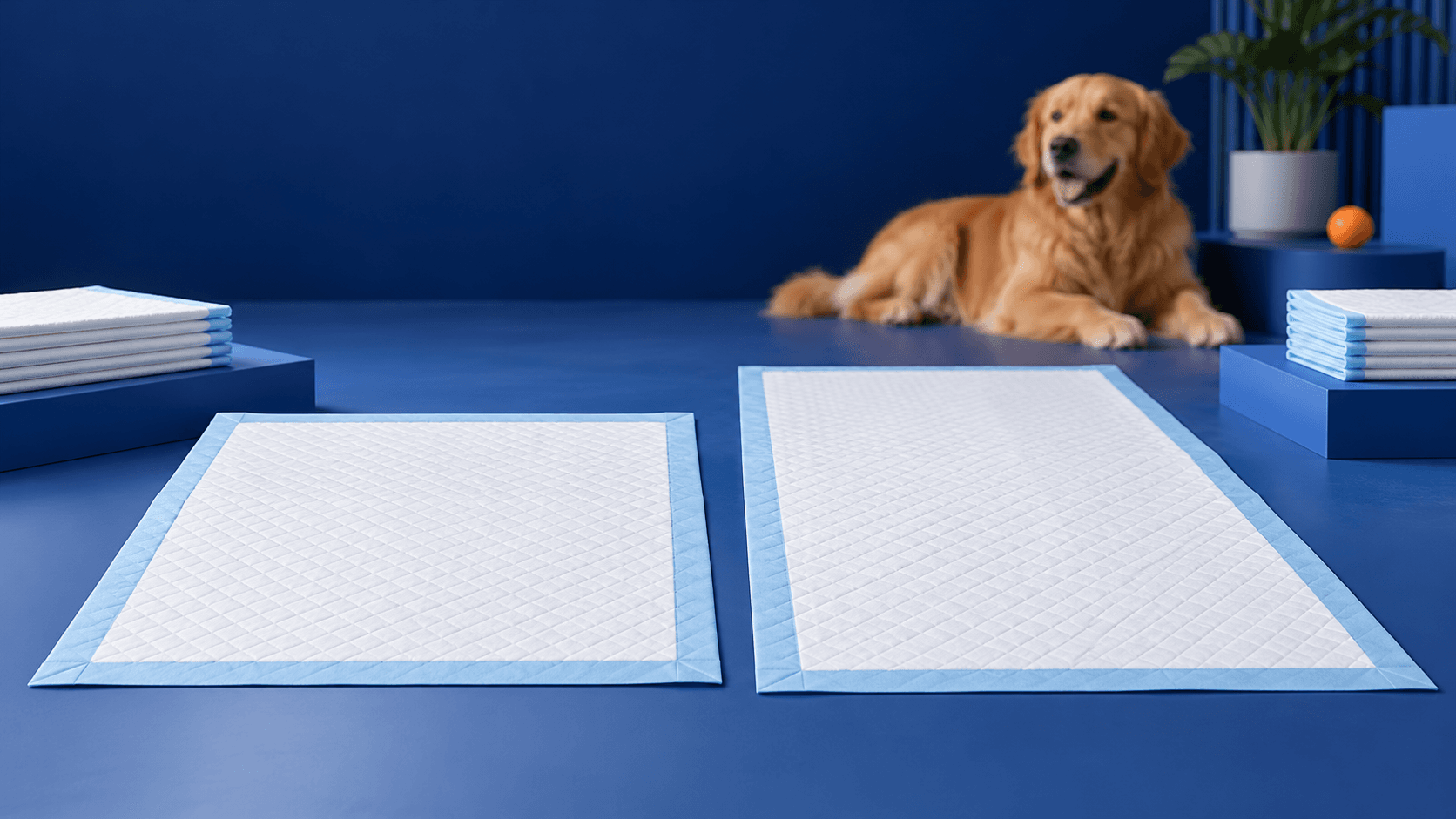
The 600 x 600 mm pad has a 0.36 m2 face area, while the 600 x 900 mm pad has a 0.54 m2 face area, making each XL pad 50% larger by footprint. The published pack references are 40 L pads and 20 XL pads; multiplying size by count gives 14.4 m2 versus 10.8 m2 of nominal pad face area per pack. These are area calculations only. They do not measure absorbency, leak resistance, usable coverage in a particular setup, or the number of uses.
A dog training pad size decision should start with the space the pad needs to cover and the way a retailer plans to sell it. Emily pets lists two reference formats: 600 x 600 mm in a 40-pad pack and 600 x 900 mm in a 20-pad pack. Buyers can compare the footprint and the total pad area per retail pack, then confirm sample performance, package details, and final order specifications before listing.
Who this guide is for
- Pet product importers comparing dog training pad formats
- Retailers and distributors planning pack counts and shelf roles
- Private-label teams preparing a dog pad assortment or RFQ
Published Dog Training Pad Size References
The pack-level area is calculated from the listed dimensions and counts. It is not an absorbency or performance comparison.
| Reference format | Pad dimensions | Pads per pack | Nominal face area per pack |
|---|---|---|---|
| L | 600 x 600 mm | 40 | 14.4 m2 |
| XL | 600 x 900 mm | 20 | 10.8 m2 |
What the Two Dog Pad Sizes Mean in Practice
The L reference is a square 600 x 600 mm pad. The XL reference is 600 x 900 mm: it keeps the same 600 mm width and adds 300 mm of length. That makes the XL footprint 50% larger per pad, based on the listed dimensions. The published pack counts differ too: 40 pads for L and 20 for XL.
For a buyer, size and pack count describe different decisions. The pad dimensions help assess fit for the intended placement; the count affects the retail unit, shelf presentation, price architecture, carton planning, and how shoppers compare packs. Do not use the word XL by itself as a substitute for showing exact dimensions on product data and artwork.
Compare Total Pad Area Without Treating It as Absorbency
Multiplying the listed dimensions by the listed pad count gives a simple nominal face-area comparison: 40 L pads at 0.36 m2 each equal 14.4 m2 per pack; 20 XL pads at 0.54 m2 each equal 10.8 m2 per pack. The L reference therefore contains more total pad face area per pack, while each XL sheet covers a larger rectangular footprint.
This calculation is useful for comparing pack architecture, but it does not show how much liquid a pad can hold, how well it contains liquid, or how it performs on a particular floor. Construction, absorbent material, test method, and use conditions matter. Buyers should assess those separately using agreed samples and comparable test conditions.
Choose the Format Around Placement and Retail Role
Start by mapping where the product will be used or displayed rather than assuming one size fits a particular dog. Measure the intended placement area, note whether a square or longer rectangular shape suits the setup, and test whether the pad stays within that footprint during the buyer's normal evaluation. The public product specification does not assign either size to a dog weight or breed, so do not make that claim without evidence.
Then consider the channel. A higher-count square pack and a lower-count rectangular pack create different shelf and price-per-pack options. Review the pack count together with target retail price, carton quantity, storage space, and the role each SKU will play in the range. Confirm these commercial details for the actual packaging proposal rather than assuming the online reference pack is the final offer.
Build a Comparable Sample Review
Before selecting a size for a private-label or wholesale program, write down the same review conditions for every sample. Record the pad dimensions, construction layers, sample identification, test liquid and quantity, floor surface, observation time, and the criteria used to judge leakage or handling. Keep observations separate from supplier specifications, and retain the approved reference sample if the project proceeds.
Emily pets' listed construction includes a non-woven top layer, highly absorbent resin, and a PE base film. Buyers should confirm the final material description and any performance criteria against the selected SKU, approved sample, destination-market requirements, and sales documentation.
- Measure the intended placement and choose a square or longer footprint based on that space.
- Compare pad dimensions and pack count as separate attributes.
- Calculate pad face area per pack only as an area comparison, not an absorbency claim.
- Agree sample identification, test conditions, and acceptance criteria before testing.
- Confirm layer descriptions, retail pack, carton configuration, artwork, and order terms in the final specification.
Wholesale and Private-Label Buyer Checklist
A clear inquiry helps a supplier quote the intended configuration rather than a generic pad. Include the target market and channel, requested L or XL dimensions, pack count, private-label status, artwork stage, carton information needed by your team, quantity range, and preferred shipping basis. Ask which details are fixed references and which can be reviewed for the specific order.
When both formats are under consideration, request comparable samples and quotations with the same assumptions. Keep size, count, construction, packaging, and shipping basis visible as separate fields in the comparison sheet. That makes it easier for procurement, regulatory, logistics, and category teams to review the same offer without mistaking a larger individual pad for more total material in the retail pack.
Preguntas frecuentes
Which pad is larger? The 600 x 900 mm XL reference has a 0.54 m2 footprint, 50% more face area per pad than the 600 x 600 mm L reference at 0.36 m2.
Which reference pack contains more total pad area? Based on the published counts, the 40-count L pack has 14.4 m2 of nominal face area and the 20-count XL pack has 10.8 m2. This calculation does not compare absorbency or leakage performance.
Does the XL pad absorb 50% more? The dimensions only establish that its face area is 50% larger. Absorbency capacity must be evaluated from verified product data or a defined sample test; it cannot be inferred from footprint alone.
What materials are listed for the dog training pads? The current product reference lists a non-woven fabric top layer, highly absorbent resin, and PE base film. Confirm the actual specification for the selected SKU before final approval.
Can pack count or artwork be customized? Pack-count and private-label planning can be discussed for the project. Final availability, packaging configuration, minimum order, and timing should be confirmed in the quotation rather than assumed from the reference packs.
Practical takeaway
Choose dog training pad size by the measured placement and required footprint, then compare pack count and nominal total pad area as separate retail decisions. Validate absorbency and leakage independently with agreed samples, and confirm the final materials, packaging, and commercial terms before approval.
Explore pet training pad specificationsLimits and confirmation points
- Dimensions, pack counts, and material layers are published product references; confirm the current specification for the selected order.
- Calculated pad face area is not a measure of absorbency, leak resistance, or number of uses.
- Destination-market labeling and performance requirements must be reviewed by the buyer for the intended market.
Sources and working references
- Puyuan official dog pads product reference
Published 600 x 600 mm and 600 x 900 mm sizes, 40/20 pack counts, and listed pad materials.