
Silica Gel Cat Litter Guide
Silica Gel Cat Litter Wholesale: A Buyer's Guide to Crystal Specifications
Learn how to source silica gel cat litter wholesale, define crystal specifications, test samples, plan private label packaging, and compare quotations.
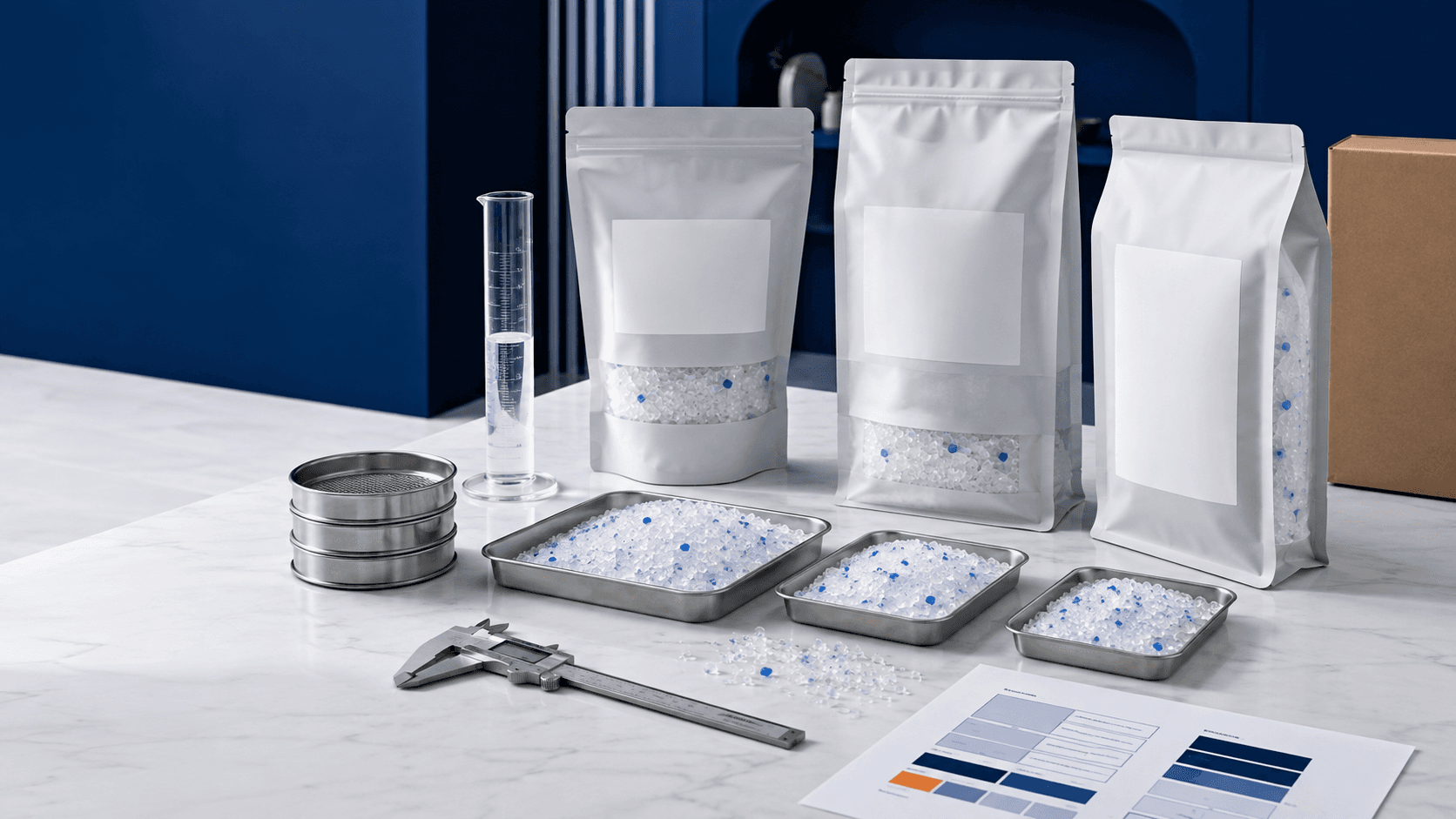
Silica gel cat litter wholesale is the bulk or private-label sourcing of porous crystal litter for importers, distributors, retailers, and pet brands. A comparable quotation should define the crystal type and shape, particle-size distribution, adsorption test, bulk density, pore volume, moisture, packaging, quantity, and destination. The current Emily pets product direction is Type C, wide-pore, non-spherical silica gel in a published 1-8 mm range. The selected SKU, approved sample, signed specification, and final contract must control every order.
What Is Silica Gel Cat Litter Wholesale?
A silica gel cat litter wholesale program combines the product specification with commercial and packaging decisions. It may include crystal selection, indicator-color direction, fragrance review, sample testing, retail bag and carton planning, artwork approval, quotation, production release, and shipment preparation. The words crystal litter, private label, OEM, and premium do not define a measurable product by themselves.
A useful first inquiry states where and how the product will be sold, which product format is required, the target pack, the expected quantity by SKU, the brand or artwork status, and the destination. Buyers should also identify every undecided item as a question. That allows a supplier to separate confirmed requirements from options that still need sampling or quotation.
- Target country and sales channel
- Crystal type, shape, and particle-size direction
- Indicator color or fragrance request, if any
- Confirmed pack size or pack options to quote
- Estimated quantity by SKU
- Private-label artwork status
- Destination and requested shipping basis
Which Crystal Specifications Should Buyers Define?
Particle range, size distribution, adsorption capacity, bulk density, pore volume, and loss on drying are different controls. Particle range describes the intended minimum and maximum crystal dimensions. The undersize and oversize limits show how much material may fall outside that range, while the qualified-size rate measures the accepted portion. Bulk density influences pack fill and loading. Pore volume and loss on drying are separate properties and should not be substituted for an adsorption result.
The current Emily pets product page lists Type C wide-pore, non-spherical silica gel; a 1-8 mm particle range; material below the minimum size at no more than 2.0%; material above the maximum at no more than 1.5%; adsorbent capacity at not less than 85%; a qualified-size rate of 90-97%; bulk density of 400-450 g/L; pore volume of 0.76-0.95 mL/g; and loss on drying of 3.82-5%. These are the current published product direction, not automatic acceptance limits for every customized order. Buyers should confirm the test method, sampling plan, tolerance, and approved sample before placing an order. An adsorption percentage should never be converted into a multiple-of-weight claim unless the test definition supports that calculation.
- Silica gel type and pore direction
- Crystal shape and visual reference
- Minimum and maximum particle size
- Undersize, oversize, and qualified-size limits
- Adsorption test method and acceptance value
- Bulk-density test method and range
- Pore volume and loss-on-drying method
- Approved sample code and retention plan
How Should a Silica Litter Sample Be Tested?
A reliable sample comparison uses the same sample mass, tray depth, liquid volume, application pattern, contact time, room conditions, and observation schedule for every candidate. Record the dry crystal appearance first. Then measure liquid uptake, visible wetness, free liquid, crystal breakage, and odor observations at defined time points. If indicator pieces are included, document their starting color, change point, distribution, and visibility rather than judging them only from a sales photograph.
Dust and tracking need separate tests. Measure loose fines when the bag is opened, particles released during pouring, and fines generated after a repeatable handling or simulated transport step. Tracking depends on crystal size, shape, tray design, fill depth, mat, and animal behavior, so one informal observation is not a universal guarantee. Statements such as dust free, non-toxic, safe if ingested, lasts 30 days, or absorbs a stated multiple of its weight require a defined method and product-specific evidence before they appear in buyer documents or packaging.
- Use equal sample mass and fill depth
- Apply the same liquid volume and pattern
- Record results at fixed time points
- Check free liquid and visible wetness
- Measure fines before and after handling
- Inspect crystal breakage and sharp fragments
- Evaluate indicator pieces under the same conditions
- Record pass, revise, reject, or retest
How Do Packaging and Loading Change the Quote?
Silica crystals are usually sold in volume-marked retail packs, but the actual fill, bag dimensions, and container plan depend on bulk density and packaging design. The current published Emily pets reference is 10 L. A quotation should still identify the bag film and barrier, dimensions, closure, carry handle, window, print method, units per carton or outer bag, pallet preference, and whether the pack protects crystals from moisture and excessive breakage during distribution.
The published planning reference lists an MOQ of one 20 GP container, approximately 10 metric tons, and lead time within 20 days after payment. These figures are not universal promises. Final MOQ, loading quantity, schedule, and payment terms depend on the selected specification, packaging, artwork readiness, palletization, destination, and signed quotation. Ask for a named Incoterms 2020 rule and named place or port. Incoterms allocate specified costs, risks, and obligations; they do not replace the product specification or complete sales contract.
- 10 L or another confirmed net-volume specification
- Bag film, barrier, dimensions, and closure
- Window, handle, zipper, and print method
- Units per carton or outer bag
- Palletized or floor-loaded plan
- Bulk-density basis for fill and loading
- Named Incoterms 2020 rule and location
- Separate artwork, plate, and packaging charges
How Should Private Label Claims Be Approved?
Private-label artwork should start from the approved product and test record, not from a competitor's package. The label should accurately identify the material and product format, net contents, use and storage instructions, disposal guidance, barcode data, and responsible company or importer information where required. Fragrance, indicator color, and any special use instruction must match the supplied SKU. Whether the selected product is described as clumping or non-clumping should be confirmed rather than assumed from the category name.
Performance, environmental, and safety statements require evidence suitable for the destination market. Claims such as low dust, 30-day use, superior odor control, biodegradable packaging, non-toxic, or safe if swallowed should be linked to a defined test, qualification, and approved product. The U.S. Federal Trade Commission's Green Guides provide a useful general principle: environmental marketing claims should be truthful, substantiated, and qualified where necessary. Destination-market labeling and import requirements still need qualified local review. Final approval should identify the dieline, language, barcode owner, net-content basis, claim evidence, version number, and sign-off date.
- Product name and format match the approved SKU
- Net contents and units are correct
- Directions reflect the tested sample
- Barcode and responsible-party data are assigned
- Performance claims have defined evidence
- Environmental and safety wording is reviewed
- Destination-market review is complete
- Final artwork version is signed
Silica Gel Cat Litter Wholesale FAQ
What particle size is available? The current published product direction is 1-8 mm. Confirm the selected SKU, size distribution, test method, and tolerance in the order specification. What pack is available? The current reference is 10 L; the final bag, carton, artwork, and loading configuration are confirmed during quotation. What is the MOQ? One 20 GP container at approximately 10 metric tons is a published planning reference, not a universal term. The signed quotation controls.
Which figures should buyers compare? Compare crystal type and shape, particle range, undersize and oversize limits, qualified-size rate, adsorption method, bulk density, pore volume, loss on drying, fines, and packaging using the same definitions. Can indicator color or fragrance be customized? Buyers may request these options, but availability, formulation, claim language, quantity, and commercial impact must be confirmed. What should the first RFQ include? Send the target market, crystal specification, sample test plan, pack size, SKU count, quantity range, artwork status, destination, and requested Incoterms basis. Reference note: product figures in this guide come from the current Puyuan and Emily pets silica gel cat litter data. Claim guidance is informed by the FTC Green Guides, and shipping-basis guidance follows ICC Incoterms 2020.
- Attach one measurable crystal specification
- Use the same test method for every sample
- List packaging requirements by SKU
- Share artwork and barcode status
- Provide quantity range and destination
- Request a named Incoterms 2020 basis
- Ask the supplier to record every deviation
- Make the approved sample part of order control
Practical takeaway
A reliable silica gel cat litter wholesale program starts with a measurable crystal specification and a repeatable sample method. Confirm the type, shape, size distribution, adsorption method, bulk density, pore volume, moisture, packaging, and loading basis; approve the sample and artwork against the same document; and use only claims supported for the selected SKU and destination market.
Explore silica gel cat litter specifications