
Bentonite Cat Litter Testing Guide
Bentonite Cat Litter Wholesale Guide: Particle Size, Dust, Clumping, and Retail Packs
Learn how to source bentonite cat litter wholesale by comparing particle size, dust, clumping, absorption, fragrance, packs, and shipping terms.
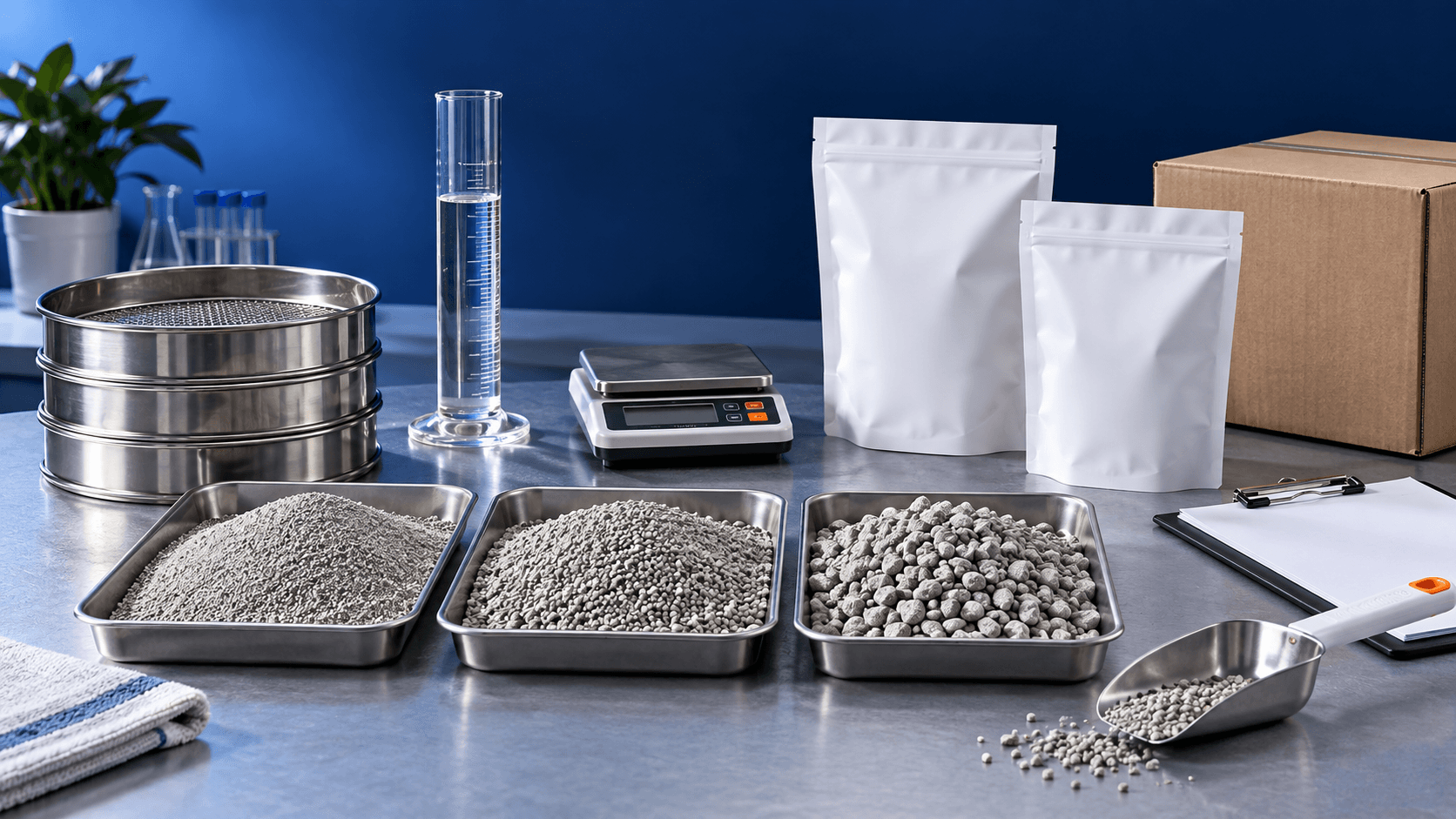
Bentonite cat litter wholesale sourcing should begin with one comparable product and test brief, not with packaging artwork alone. Importers, distributors, retailers, and private-label buyers need to define particle distribution, dust method, clumping procedure, absorption basis, fragrance direction, pack format, quantity, destination, and quotation basis before comparing suppliers. Current Emily pets product data publishes several particle-size options, dust and moisture references, clumping and absorption figures, fragrance directions, retail pack references, and container-planning terms. These values are starting points for a buyer discussion. The approved coded sample, written specification, packaging proof, quotation, and sales contract must control the final order.
What Should a Bentonite Cat Litter Wholesale Brief Define?
A bentonite cat litter wholesale brief connects the product specification to the target market and retail program. It should state whether the proposed SKU is an entry, core, premium, or promotional item; the intended sales channel; the target retail pack; and the measurable sample checks that will determine approval. This prevents a visually attractive bag from becoming a substitute for product control.
Current Emily pets data lists natural sodium bentonite and several product directions, including particle options of 0.5-1.5 mm, 1-3 mm, and 2-4 mm. A Love Sand SKU separately lists a 1-4 mm granule range with spherical, crushed, or customizable shapes. Buyers should select the relevant SKU and sample code rather than combining specifications from different product directions.
The first inquiry should also identify fragrance preference, number of planned SKUs, expected quantity range, artwork status, destination port or city, and requested shipping basis. Any item that has not been verified should remain an open sample, evidence, label, packaging, or commercial question.
- Destination market and sales channel
- Entry, core, premium, or promotional SKU role
- Selected bentonite product and coded sample
- Particle-size and shape direction
- Dust, clumping, and absorption test priorities
- Fragrance or unscented direction
- Retail pack, carton, and artwork status
- Quantity range, destination, and quotation basis
How Should Buyers Compare Particle Size and Dust?
Particle size affects appearance, scoop handling, tracking observations, packing density, and the way liquid moves through a test bed. Do not compare only the nominal range on a data sheet. Ask how the range is measured, which sieves are used, how long the sample is shaken, and what percentage falls below or above the selected limits.
Use the same sample mass, sieve stack, shaking time, collection tray, and reporting format for every candidate. Record the mass retained on each sieve and calculate each fraction as a percentage of the starting sample. Photograph the separated fractions under consistent lighting and keep the result linked to the sample code and lot date.
Dust also needs a defined method. Current Emily pets product directions publish dust references below 0.5 percent for selected Easy Clean formats and no more than 1 percent for the listed Love Sand direction. These values should be tied to the selected SKU and agreed method. A visual pour test, a sieve result, and an airborne-particle observation are different checks and should not be reported as one number.
- One sample mass and conditioning period
- Agreed sieve sizes and shaking time
- Mass retained by each particle fraction
- Allowed undersize and oversize limits
- Defined dust method and reporting unit
- Consistent pour height and collection surface
- Photos under the same lighting
- Sample code, lot reference, and test date
How Can Clumping and Absorption Be Tested Fairly?
Clumping time and water absorption are not interchangeable. Clumping time describes how quickly a sample forms a removable mass under a stated procedure. Absorption describes liquid uptake under a separate method. A useful supplier comparison defines the litter depth, sample mass, liquid type, liquid volume, pouring height, contact time, scoop design, lifting angle, and number of repetitions before testing begins.
Current Emily pets data publishes a 2-5 second clumping-time reference and 300-350 percent water-absorption reference for selected bentonite directions, while one Love Sand direction lists water absorption of at least 350 percent. These figures are product-page references, not universal guarantees. Buyers should confirm the exact method, sample, and acceptance range in the quotation and specification.
For clump handling, record formation time, lifted mass, visible breakage, residue left in the tray, and behavior after fixed waiting periods. For absorption, record the dry sample mass, applied liquid, drained or unabsorbed liquid when relevant, and calculation used. Repeat the procedure enough times to identify variation rather than relying on one favorable result.
- Fixed litter depth and sample mass
- Defined liquid type, volume, and temperature
- Consistent pour height and application point
- Fixed waiting times before scooping
- One scoop design and lifting method
- Clump mass, breakage, and residue notes
- Separate absorption calculation
- Multiple repetitions with all results retained
Which Moisture, Strength, Fragrance, and Odor Checks Matter?
Moisture, particle strength, fragrance, and odor should be reviewed separately because each can influence storage, handling, and consumer experience. Current Emily pets bentonite data publishes moisture below 8 percent and compressed resistance above 400 g for selected product directions. Confirm the instrument, sample preparation, number of readings, and force-test setup before treating either value as an acceptance limit.
Fragrance names are not complete sensory specifications. Published directions include apple, lemon, lavender, rose, green tea, coffee, baby powder, and original options across selected SKUs. A buyer should approve fragrance against a coded litter sample and sealed packaging sample, then define acceptable intensity and any restricted ingredient or labeling requirements for the destination market.
Evaluate natural mineral odor, added fragrance, packaging odor, damp or unusual odor, and foreign odor as separate observations. Use coded samples at the same temperature and ventilation conditions. Record whether each result is measured, sensory, visual, or awaiting documentation so that subjective impressions do not become unsupported technical claims.
- Moisture instrument and sampling locations
- Number of readings and decision rule
- Strength fixture, force direction, and sample count
- Approved fragrance code and intensity range
- Natural, packaging, damp, and foreign odor notes
- Destination ingredient and label review
- Sealed retention sample for comparison
- Reapproval after formula or fragrance changes
How Do Retail Packs and Claims Change the Quote?
Published Emily pets bentonite pack references include 5 L, 10 L, 5 kg, 10 kg, 20 kg, and 25 L across selected directions. The listed Love Sand format also references a 10 L or 8 kg handled bag. A quotation should identify the exact product, net quantity, bag structure, dimensions, closure, handle, print method, carton or outer pack, shipping marks, and pallet preference rather than using a pack name alone.
Volume and weight are different declarations. If a program uses liters, confirm the fill method and density basis used to establish the declared volume. If it uses kilograms, confirm net-weight control and tolerance. Final sealed dimensions and unit counts should be used for carton and container planning because artwork dimensions or an empty-bag drawing cannot predict the loaded pack accurately.
Do not place fast clumping, low dust, high absorption, odor control, natural, safe, antibacterial, flushable, eco-friendly, or similar claims on private-label artwork without defining the selected SKU, test method, evidence, wording limits, and destination requirements. Separate product, packaging, plate, artwork, sample, inspection, and logistics charges when comparing offers.
- Exact SKU and approved sample code
- Net weight or volume declaration basis
- Bag material, dimensions, closure, and handle
- Print colors, artwork, barcode, and languages
- Carton or outer-pack configuration
- Evidence basis for every objective claim
- Final sealed dimensions for loading
- Charges and assumptions shown separately
What Should a Bentonite Cat Litter RFQ Include?
A decision-ready RFQ gives every supplier the same product, test, packaging, quantity, and delivery assumptions. Attach the target particle distribution, dust method, clumping and absorption procedures, moisture and strength questions, fragrance direction, retail pack specification, artwork status, quantity by SKU, destination, and requested Incoterms rule with a named place or port.
Current Emily pets planning data lists one 20 ft container as the MOQ for selected bentonite directions, approximately 23-26 metric tons per 20 ft container, lead time within 20 days after T/T payment, and FOB Dalian as a published starting basis. A listed Love Sand 10 L Black Series direction separately references approximately 26 metric tons and a different printed-packaging schedule. These figures are planning references, not automatic terms for every order.
Ask the quotation to state which values are confirmed, which depend on sample approval, and which remain subject to packaging, production, destination, or shipping review. Final MOQ, loading quantity, lead time, payment, freight, label scope, and customization costs must be confirmed in the formal quotation and sales contract.
- Target market, channel, and SKU role
- Product specification and coded sample
- Particle, dust, clumping, and absorption methods
- Moisture, strength, fragrance, and odor checks
- Retail and outer packaging by SKU
- Quantity range and destination
- Named Incoterms rule and location
- Supplier assumptions, deviations, and open items
Practical takeaway
Reliable bentonite cat litter wholesale sourcing depends on a repeatable comparison, not one headline specification or attractive bag. Define particle distribution, dust, clumping, absorption, moisture, strength, fragrance, retail packaging, quantity, destination, and shipping basis in writing. Keep the approved sample, test record, specification, artwork proof, quotation, and sales contract aligned, and publish performance claims only when the selected SKU, method, evidence, and destination rules support them.
Compare bentonite cat litter specifications