
Dog Pee Pad Sourcing Guide
Dog Pee Pad Wholesale Guide: Construction, Absorbency Tests, Leakage, and Private Label Packs
Learn how to source dog pee pads wholesale, compare construction and leakage tests, and plan private-label sizes, pack counts, cartons, and RFQ terms.
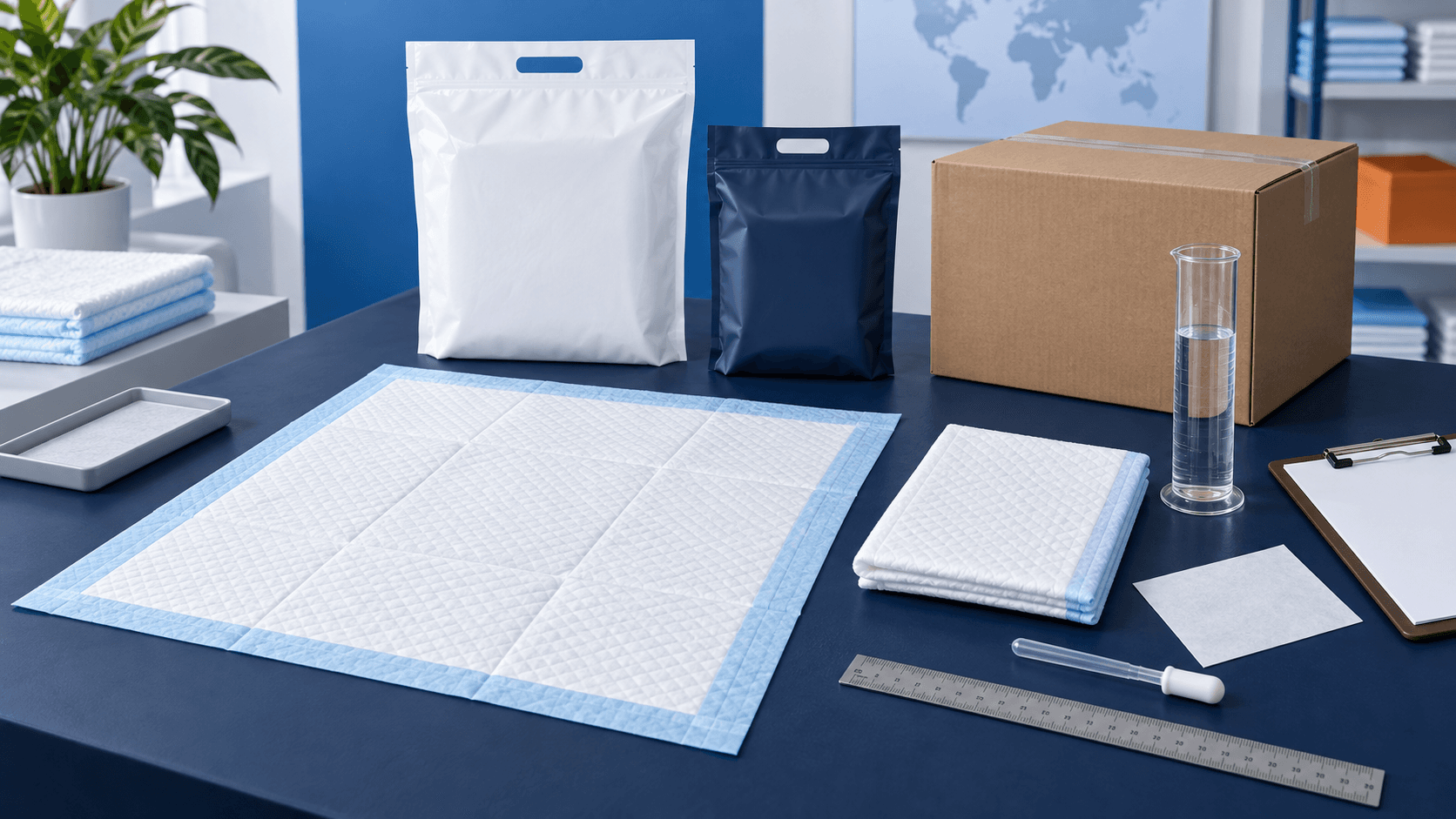
Learn how to source dog pee pads wholesale, compare construction and leakage tests, and plan private-label sizes, pack counts, cartons, and RFQ terms. A useful wholesale brief should define the intended pet and use case, pad dimensions, construction materials, absorbency test method, liquid volume, surface-dryness method, backing and edge-seal checks, retail pack count, outer packaging, quantity by SKU, destination, and quotation basis. Current Emily pets product data lists 600 x 600 mm and 600 x 900 mm formats, 40-pad and 20-pad pack references, a non-woven top layer, highly absorbent resin, and a PE base film. The selected SKU, coded sample, written specification, packaging proof, and final quotation must control each order.
What Is Dog Pee Pad Wholesale?
Dog pee pad wholesale is the bulk or private-label sourcing of disposable pet training pads for retailers, distributors, supermarkets, pet brands, and other volume buyers. The program can include pad construction, size and absorbency selection, coded sample testing, retail packaging, carton planning, artwork approval, production release, inspection, and shipment preparation.
The phrase private label explains whose brand appears on the pack; it does not define the pad. Two products described as dog pee pads can differ in dimensions, top-sheet feel, absorbent-core composition, liquid distribution, surface dryness, backing behavior, edge sealing, folded size, pack count, and carton configuration. Buyers should therefore start with a measurable specification rather than a reference image or a request for the lowest price.
A useful first inquiry states the target market, sales channel, intended pet size, primary use, required pad dimensions, expected retail position, quantity range, number of SKUs, artwork status, destination, and requested shipping basis. Mark undecided items as sample questions so the supplier can separate confirmed requirements from options that still need evaluation.
- Target market and sales channel
- Puppy training, daily indoor use, travel, senior-pet care, or another defined use
- Intended pet-size range and household use pattern
- Required pad dimensions and retail pack count
- Private-label artwork and barcode status
- Quantity range by SKU
- Destination and requested quotation basis
- Decisions that must be closed by samples
Which Dog Pee Pad Construction Details Should Buyers Specify?
Write each construction component separately. Current Emily pets product information lists a non-woven fabric top layer, highly absorbent resin as the absorbent material, and a PE base film. It also lists an L direction at 600 x 600 mm and an XL direction at 600 x 900 mm. These are current published references, not automatic specifications for every customized order.
The written specification should state how dimensions are measured, including whether the sealed border is included. Buyers should also confirm the visible top-sheet pattern, color, odor or fragrance direction, absorbent-core distribution, backing color and texture, edge width, seal continuity, folded format, individual pad mass, and permitted variation. Do not assume the number or composition of internal layers from a marketing image; request a construction description for the selected SKU.
Approve construction against a coded sample and a version-controlled specification. If the top sheet, absorbent material, core distribution, base film, dimensions, fragrance, or packing method changes after approval, record the change and decide whether a new sample test is required.
- Finished length and width with measurement method
- Top-layer material, color, texture, and visible pattern
- Absorbent-core material and distribution direction
- PE base-film color, feel, and continuity
- Edge width, corner shape, and seal acceptance criteria
- Folded dimensions and fold pattern
- Individual pad mass and agreed tolerance
- Approved and retained sample code
How Should Buyers Test Absorbency and Liquid Distribution?
Words such as high absorbency, fast absorption, or premium core are not comparable until the test method is fixed. Use the same test liquid, temperature, pad conditioning, sample count, application volume, pour rate, application point, timing, surface, and reporting format for every candidate. If the product will be used by different pet sizes, test more than one realistic loading scenario rather than choosing a single dramatic demonstration.
One practical buyer procedure can place a conditioned pad on a flat, non-absorbent surface, apply a defined volume at a controlled rate to a marked point, and record the time until free liquid is no longer visible. Repeat at the center and other agreed positions to observe distribution consistency. A second application after a fixed interval can help compare how the selected construction behaves under repeated use. Record visible pooling, channeling, uneven core areas, swelling, deformation, and the spread boundary.
Total liquid added is not the same as retained liquid or useful performance. If retention is important, agree on a drain or pressure step and weigh the pad before and after the test using the same timing. Report the method, observations, and result without converting a small sample exercise into a universal product claim.
- Use coded samples and the same conditioning period
- Define test liquid, temperature, and application volume
- Control pour rate, height, point, and interval
- Record disappearance time and spread pattern
- Repeat at agreed positions and loading stages
- Define any drain, pressure, and weighing step
- Photograph results under consistent lighting
- Classify each sample as pass, revise, reject, or retest
How Should Surface Dryness, Leakage, and Edge Sealing Be Checked?
Surface dryness and backing leakage are separate questions. A pad can move liquid below the top sheet yet still transfer moisture back under pressure. It can also retain liquid in the core while leaking through a damaged backing or incomplete edge seal. Use distinct checks and define the decision threshold before comparing samples.
For a repeatable surface-dryness comparison, wait a fixed time after applying the agreed liquid volume, place the same absorbent paper or other agreed contact material on the test area, apply a controlled load for a fixed duration, and measure or visually grade the transfer. Keep the contact area, load, time, and grading scale identical. For leakage, inspect the non-absorbent surface below the pad after the loading sequence and again after a defined pressure or handling step.
Review the full perimeter for open seals, wrinkles, thin areas, exposed core material, or damaged film. If the pad is folded for packing, inspect crease lines after opening and after the test. Buyers should also document whether the pad shifts, curls, tears, or bunches during the agreed handling simulation. Claims such as leak-proof, quick-dry, odor-control, antibacterial, or hypoallergenic require product-specific evidence and destination-market review before they appear on artwork.
- Fixed wait time before the dryness check
- Standard contact material, load, area, and duration
- Defined grading or transferred-moisture method
- Visual check beneath the pad for leakage
- Edge and corner inspection before and after loading
- Fold-line and backing inspection after opening
- Handling observations recorded separately from measured results
- Evidence review for every objective packaging claim
How Do Pad Size, Pack Count, and Cartons Affect a Private Label Quote?
Current Emily pets product information lists 600 x 600 mm with a 40-pad pack reference and 600 x 900 mm with a 20-pad pack reference. These combinations can provide a starting point for range planning, but the final quotation should identify the exact pad construction, individual pad mass, folded dimensions, retail bag material, pack count, closure, printed area, carton count, carton dimensions, shipping marks, and pallet preference.
A larger pad or a higher pack count changes more than the front-panel number. It can affect bag dimensions, carton utilization, shelf footprint, handling weight, warehouse space, loading calculations, and freight assumptions. Compare supplier quotations only when they use the same pad specification, pack count, bag requirement, carton configuration, print scope, SKU quantity, and loading basis.
Private-label artwork should not be finalized before the product and pack are selected. The net quantity statement, dimensions, use directions, warnings, disposal wording, material or performance claims, importer information, barcode, language, and destination requirements should be reviewed against the chosen SKU. Show artwork, plate, cylinder, sample, inspection, and packaging charges separately when applicable.
- 600 x 600 mm, 600 x 900 mm, or another confirmed size
- 40-pad, 20-pad, or another confirmed pack count
- Folded pad dimensions and retail bag dimensions
- Bag material, closure, print method, and artwork scope
- Units per carton and final carton dimensions
- Shipping marks and pallet preference
- Quantity by size, pack, artwork, and destination
- Separate one-time and recurring packaging charges
What Should a Dog Pee Pad Wholesale RFQ Include?
A decision-ready RFQ connects the intended use to one measurable product and packaging basis. Include the target market, channel, pet-size direction, use case, dimensions, construction questions, sample method, pack count, private-label status, quantity range by SKU, destination, and requested Incoterms rule with a named place or port. Ask the supplier to identify every assumption, option, and deviation instead of silently substituting a standard product.
What sizes are currently published? Emily pets lists 600 x 600 mm and 600 x 900 mm directions; confirm the final dimensions and measurement method. Which pack counts are listed? The current references are 40 pads for the L format and 20 pads for the XL format. What materials are identified? The current page lists a non-woven fabric top layer, highly absorbent resin, and a PE base film. How should samples be compared? Test liquid distribution, surface dryness, backing leakage, edge sealing, dimensions, and construction using one documented method. Can private-label packaging be discussed? Yes, after the selected pad specification, pack count, artwork scope, quantity, and destination are clear.
Final MOQ, customization feasibility, loading quantity, production schedule, payment terms, sample charges, packaging costs, and shipping terms depend on the selected construction and commercial plan. Treat website information as a starting point and use the signed quotation, approved sample, packaging proof, and sales contract as the final order records.
- Attach one measurable pad specification
- Define one repeatable sample test plan
- State size and pack count by SKU
- Provide artwork, barcode, and label-language status
- Share quantity range and destination
- Request a named Incoterms rule and location
- Ask for pack and loading assumptions in writing
- Record every approved deviation and revision
Practical takeaway
A reliable dog pee pad wholesale program starts with a defined use case and construction, then compares coded samples using repeatable checks for liquid distribution, surface dryness, backing leakage, edge sealing, and handling. Confirm pad size, pack count, private-label artwork, carton configuration, quantity, and shipping basis in writing. Keep the approved sample, specification, packaging proof, and quotation aligned, and publish objective performance claims only when evidence for the selected SKU and destination market supports them.
Explore dog pee pad specifications