
Sourcing Guide
Wood Shavings Wholesale Sourcing Guide: Size Grades, Moisture, Dust Claims, and Retail Packs
Learn how to source wood shavings wholesale, compare size grades and moisture, verify dust claims, and plan private-label retail packs and shipping terms.
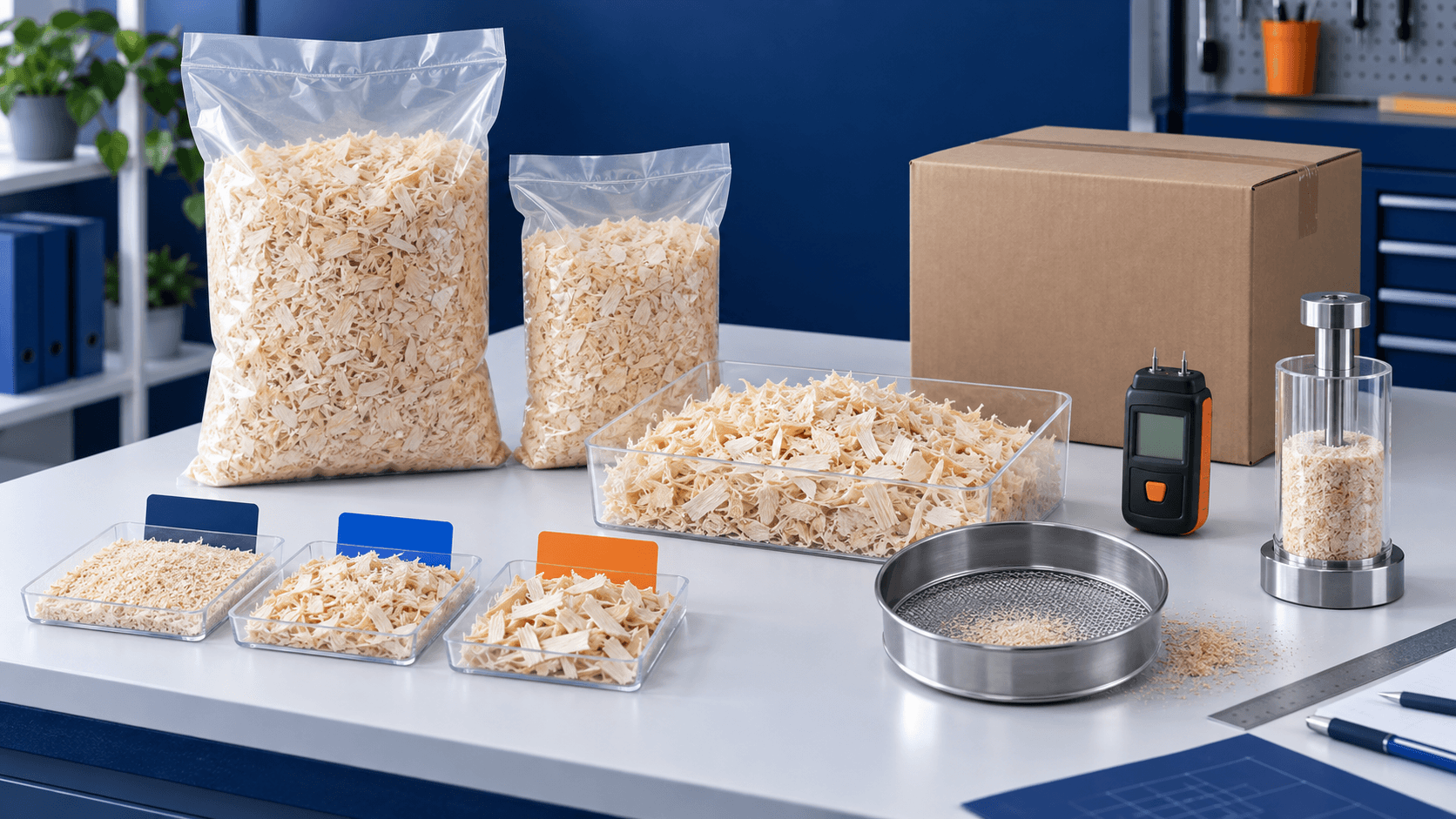
Learn how to source wood shavings wholesale, compare size grades and moisture, verify dust claims, and plan private-label retail packs and shipping terms. A usable wholesale brief should define the wood-material direction, particle-size distribution, moisture limit, appearance, visible-fines method, fragrance, compressed-pack recovery, retail weight, outer-pack configuration, quantity, destination, and shipping basis. Current Emily pets product data lists birch and pine directions, several particle-size options, less than 10% moisture, white to faint-yellow appearance, 500 g, 1 kg, and 4 kg pack references, and optional fragrance directions. The selected SKU, approved sample, written specification, artwork, and final quotation must control each order.
What Is Wood Shavings Wholesale?
Wood shavings wholesale is the bulk or private-label sourcing of processed wood bedding for small-pet retail, distributor, or brand programs. It combines a measurable product specification with sample evaluation, packaging development, quotation, production release, and shipment planning. Private label or OEM describes how the product is sold; it does not define the material, size distribution, moisture, dust level, fragrance, or pack behavior.
A useful first inquiry states the target country, sales channel, intended small-pet category, required material direction, retail role, pack size, number of SKUs, quantity range, artwork status, destination, and requested shipping basis. Buyers should mark every undecided item as a question. This separates confirmed requirements from options that still need sampling, testing, label review, or quotation.
- Target market and sales channel
- Intended small-pet category and retail role
- Birch, pine, or another confirmed material direction
- Particle-size range and appearance target
- Unscented or fragrance samples required
- Retail weight and outer-pack preference
- Quantity range and number of SKUs
- Destination and requested shipping basis
Which Wood Shaving Specifications Should Buyers Define?
Material, particle distribution, moisture, appearance, fines, odor, and compression are separate controls. A size label should name the accepted range and the sampling method, not only a general term such as fine or premium. Current company materials list several size directions, including 0.5-1.5 mm, 0.5-2.5 mm, 1-3.5 mm, 1-4 mm, and 1-5 mm. These are product options to confirm, not automatic specifications for every order.
The current published direction also lists moisture below 10%, white to faint-yellow chip appearance, and apple, lemon, lavender, or special-request fragrance options. Buyers should request a coded reference sample for the selected combination. If material, size, moisture method, fragrance, compression, or packaging changes, confirm whether a new sample approval is required.
- Confirmed wood-material description
- Accepted particle-size range and sieve method
- Oversize, undersize, and visible-fines limits
- Moisture method and maximum value
- Color and visual reference sample
- Odor or fragrance formula and intensity reference
- Foreign-material inspection method
- Approved and retained sample code
How Should Buyers Compare Size, Moisture, Dust, and Recovery?
Use the same sample mass, sieve set, shaking time, equipment, and reporting format for every candidate. Record the percentage retained on each relevant sieve instead of relying only on the product's stated size range. Photograph coded samples under fixed lighting and note long chips, short fibers, fines, and foreign material separately.
For moisture, agree on the instrument or laboratory method, sample conditioning, test temperature, and number of readings. For dust or fines, define what is being measured. One practical procedure can record loose fines in the unopened sample, particles released during a fixed pouring test, and fines produced after a repeatable compression, transport, or handling simulation. Record sample mass, drop height, collection method, and result.
Compressed-pack recovery also needs a repeatable method. Use the same starting mass, pack condition, opening procedure, recovery time, and measuring container. Record recovered volume and visible structure without turning a single sample observation into a universal performance claim.
- Use one sample mass and sieve standard
- Set one shaking time and result format
- Measure moisture with an agreed method
- Test fines before and after handling
- Use one pouring height and collection setup
- Record compressed-pack recovery at fixed times
- Photograph coded samples under fixed lighting
- Classify each sample as pass, revise, reject, or retest
How Should Dust, Safety, and Environmental Claims Be Reviewed?
The current product page uses dust-free wording. Buyers should not copy that phrase directly into specifications or retail artwork without a defined method, acceptance value, and supporting evidence for the selected SKU. A clean photograph or a supplier statement does not show how much fine material is present after packing and distribution. The U.S. Federal Trade Commission's advertising substantiation policy provides a useful general principle: objective product claims should have a reasonable basis before publication.
The same discipline applies to natural, chemical-free, hypoallergenic, safe, absorbent, odor-control, biodegradable, compostable, and species-health claims. Each statement may communicate a measurable or safety-related promise. Confirm the exact material and formula, identify the evidence, define the claim's limits, and review the wording for the destination market before artwork approval. Do not infer certification, forest origin, veterinary benefit, or disposal suitability from the product category alone.
- Separate visual observations from measured claims
- Link each objective claim to the selected SKU
- Record the test method, sample, result, and date
- Review safety and species-use language separately
- Avoid broad environmental claims without evidence
- Confirm destination-market label requirements
- Keep claim evidence with the artwork version
- Reapprove claims after a material or process change
How Do Retail Packs and Outer Packaging Affect the Quote?
Current published packaging references are 500 g with 36 bags per PP outer bag, 1 kg with 24 bags per PP outer bag, and 4 kg with 6 bags per PP outer bag. These references help buyers start a pack brief, but a complete quotation should also define the retail bag material, barrier, dimensions, seal or zipper, print method, compression ratio, recovered volume method, outer-pack structure, shipping marks, pallet preference, and moisture protection.
Lightweight products can be limited by volume before weight, so final compressed dimensions and pack recovery affect warehouse, carton, pallet, and container planning. Compare quotations only when the product specification, retail pack, outer-pack count, print scope, SKU quantity, and loading assumptions match. Artwork, plate, sample, and inspection charges should be shown separately when applicable.
- 500 g, 1 kg, 4 kg, or another confirmed retail weight
- Bag material, dimensions, closure, and compression
- Recovery-volume method and label wording
- Units per PP outer bag or carton
- Artwork, plate, and printing charges
- Shipping marks and moisture protection
- Palletized or floor-loaded plan
- Final pack dimensions used in loading calculations
How Should Buyers Request MOQ, Lead Time, and Shipping Terms?
The current product page lists one 20 GP container at approximately 10 metric tons as an MOQ and loading reference, delivery within 20 days after payment, and T/T payment. These are published planning references, not universal promises. Final MOQ, loading quantity, production schedule, payment terms, and packaging charges depend on the selected material, size, fragrance, pack, artwork readiness, quantity by SKU, destination, and signed quotation.
Request a named Incoterms 2020 rule and a precise named place or port. ICC guidance explains that the selected rule and location help allocate delivery, cost, risk, and formalities responsibilities. Incoterms do not replace the product specification, payment terms, inspection agreement, title transfer terms, or complete sales contract.
What sizes are available? Current published directions include 0.5-1.5 mm, 0.5-2.5 mm, 1-3.5 mm, 1-4 mm, and 1-5 mm; confirm the selected range, method, and tolerance. What moisture level is listed? Less than 10% is the current reference, subject to an agreed test method. Is the product dust free? Treat dust-free as a claim that requires a defined method and evidence for the selected SKU. Which pack sizes are listed? Current references are 500 g, 1 kg, and 4 kg with specified outer-bag counts. What should the first RFQ include? Send the market, intended small-pet category, material and size questions, test plan, fragrance direction, pack brief, SKU count, quantity range, destination, and requested Incoterms basis.
- Attach one measurable product specification
- Use the same test method for every sample
- Define fragrance and unscented options separately
- State retail and outer packaging by SKU
- Provide quantity range and destination
- Share artwork and barcode status
- Request a named Incoterms 2020 rule and location
- Ask the supplier to record every deviation
Practical takeaway
A reliable wood shavings wholesale program starts with a measurable material and particle specification, then uses repeatable checks for moisture, fines, compression, and pack recovery. Confirm the selected SKU, sample method, fragrance, packaging, quantity, and shipping basis in writing; approve the product sample and artwork against the same document; and publish objective claims only when evidence for the selected product and destination market supports them.
Explore wood shaving specifications